

Past fifty, what bothers you is no longer a wrinkle: it is the neck loosening and the jawline softening, especially in a photo taken from the side. A friend mentioned Ultherapy, or your doctor did. It is the name people know: it has been around for more than fifteen years.
Today there is another device, which arrived in Canada in 2025: XERF. It targets the same loosening, without surgery or needles, and according to its manufacturer without numbing or downtime. We compared the two, source by source, before choosing the one we offer. Here is the comparison, honest on both sides.
XERF: a radiofrequency that firms the face and neck.
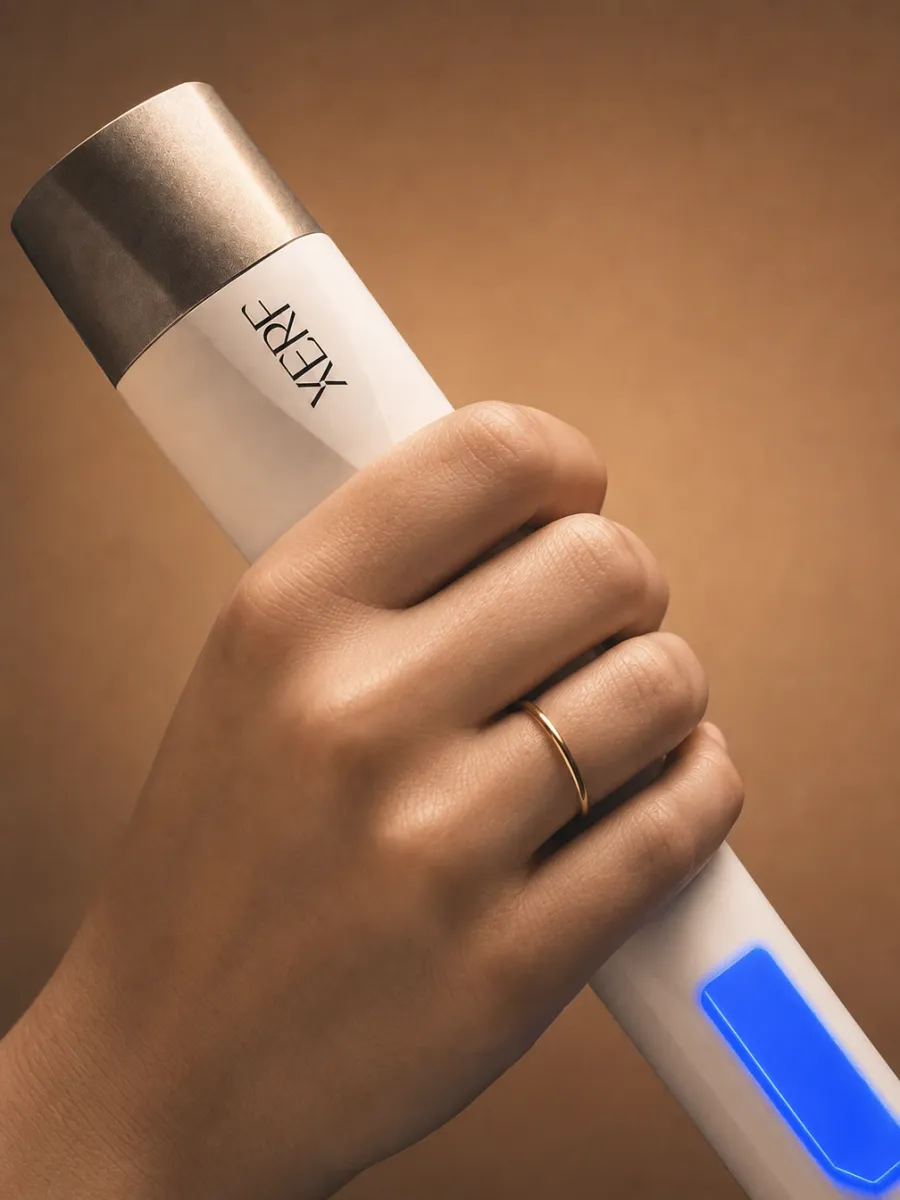
XERF is made by Cynosure Lutronic and authorized in Canada since 2025. It heats the skin below the surface to tighten it and restart collagen, while built-in cooling protects the surface. Here is what the treatment looks like at Clinique DC.
| What is treated | The full face, down to under the eyes, and the neck |
|---|---|
| The session | 90 min, no needles or numbing |
| How often | Two sessions, then yearly upkeep |
| Afterwards | No downtime |
| The result | Immediate, then gradual over 3 to 6 months |
| The price | $1,500 per session, taxes extra |
Two devices, one goal: tighten skin that is loosening.
Both heat the skin below the surface to tighten it and restart collagen production. Neither cuts, and neither needs a needle.
- They don’t remove excess skin: when skin hangs and folds at rest, the honest answer is surgery.
- They don’t restore volume to a hollowed cheek: that is what filler does.
What sets them apart, point by point.
What comes from a manufacturer is labelled as such. The rest comes from the studies cited at the end.
| Criterion | XERF | Ultherapy |
|---|---|---|
| Energy | Radiofrequency, two frequencies in the same pulse (manufacturer) | Microfocused ultrasound |
| How the heat is delivered | A volume of tissue heated under the tip | Points of heat, lined up at a fixed depth |
| During the session | No numbing, built-in cooling (manufacturer) | Average pain of 4.85 out of 10 in a 2025 meta-analysis |
| What the device measures | The skin’s resistance, with every pulse (manufacturer) | An ultrasound image of the treated layers |
| Afterwards | No downtime | No downtime per the manufacturer; short-lived redness or swelling |
| Sessions | Two sessions, then yearly upkeep (at Clinique DC) | Often one, according to the manufacturer |
| Full result | Immediate, then gradual over 3 to 6 months | In 2 to 3 months, according to the manufacturer |
| Track record | Authorized in Canada in 2025 | Cleared in the United States since 2009 |
| Published studies | Few, recent, tied to the manufacturer | Many, including a 2025 meta-analysis |
| At Clinique DC | $1,500 per session, full face and neck | Not offered |
XERF wins where the session is lived: during it, and after.
Four points where the difference is clear, each with where the fact comes from.
No numbing
According to the manufacturer, XERF needs none: built-in cooling protects the surface during every pulse. For Ultherapy, the 2025 meta-analysis reports an average pain rated moderate, 4.85 out of 10.
No downtime
You resume your day as you leave. And a session that goes well is one you agree to repeat at the yearly upkeep.
Energy is dosed with every pulse
The device reads the skin’s resistance and adjusts the energy, according to the manufacturer. The person holding it chooses the depth and intensity.
Full face and neck, one price
$1,500 per session covers the whole face, down to under the eyes, and the neck. The price is posted, taxes extra.
Ultherapy has the track record, and it should be said.
An article that only praises one device doesn’t help you choose. What Ultherapy does better:
- Over fifteen years of track record: cleared in the United States in 2009 to lift the brow, then in 2012 for under the chin and the neck.
- Many more studies, including a meta-analysis published in 2025. Those on XERF are recent, small and tied to the manufacturer.
- An ultrasound image on screen, showing the layers of the skin before each pass.
- Often a single session, according to the manufacturer.
No study compares the two devices.
It is the most important fact, and almost nobody writes it: the pages comparing the two at the top of Google are clinic pages, not studies. Here is what actually exists.
| Study | Device | What it shows, and its limit |
|---|---|---|
| Amiri et al., 2025 | Ultherapy | Meta-analysis: clear improvement and satisfaction, moderate pain, good safety |
| Humphrey et al., 2025 | Ultherapy | Review of 19 papers, 506 patients: mostly short-lived effects (swelling, redness, pain) |
| Alam et al., 2010 | Ultherapy | Photos rated blind at 90 days; study funded by the manufacturer |
| Erlich et al., 2026 | XERF | 16 women, one session, 3-month follow-up; first author is a manufacturer trainer |
| Hong et al., 2024 | XERF | Tissue analysis, no patient results; authors employed by the manufacturer |
What it means: Ultherapy is better documented, and XERF is still thinly documented. Neither has been shown superior to the other. So the choice comes down to what you want to go through, and to your skin.
The right choice depends on what you are ready to go through.
| If… | Rather |
|---|---|
| You want neither marked pain nor numbing cream | XERF |
| You want the full face and neck, at a price known in advance | XERF |
| You want the device with the longest track record and most studies | Ultherapy |
| You want a single session, even if it is uncomfortable | Ultherapy |
| Your skin hangs and folds at rest | Neither: surgery |
| It is mostly volume that is missing | Neither: filler |

Why we chose XERF.
We wanted a treatment our patients would agree to repeat. Firming doesn’t stop at the first session: it is maintained. A session without numbing or downtime is one you come back for the following year.
We also wanted to treat the face and neck in the same appointment, at a price we can post. And we wanted to know it inside out: the clinic’s owner is a trainer at Cynosure Lutronic, the XERF supplier.
A good device is one you agree to come back for the following year.
Questions we get asked
Is it too late at 60?
Age doesn’t decide, the skin does. XERF tightens loosening skin; it doesn’t remove skin that hangs and folds at rest. The free 3D skin analysis is there to tell you before you pay anything.
I had never heard of XERF. Is it authorized in Canada?
Yes, since 2025. That is why you hear less about it than Ultherapy, cleared in the United States since 2009. It is made by Cynosure Lutronic.
Is Ultherapy HIFU?
Yes. HIFU is the name of the technique, focused ultrasound; Ultherapy is a specific device in that family, with an ultrasound image. XERF is not HIFU: it is radiofrequency.
Do you offer Ultherapy at Clinique DC?
No. For firming the face and neck we chose XERF, and TempSure for a smaller budget (from $100 per zone). We give no price for a treatment we don’t offer.
Which one hurts more?
No study compares them directly. What we know: XERF’s manufacturer says no numbing is needed, and for Ultherapy a 2025 meta-analysis reports an average pain of 4.85 out of 10, rated moderate.
Which one lasts longer?
No study compares how long they last. Ultherapy’s manufacturer speaks of results lasting up to a year or more. For XERF, we do two sessions, then yearly upkeep.
How much does XERF cost in Laval?
$1,500 per session at Clinique DC, full face and neck, taxes extra. Payment can be spread over instalments with Klarna.
Does XERF replace a facelift?
No. It tightens loosening skin; it doesn’t remove excess skin. If your skin hangs at rest, the 3D skin analysis is also there to tell you so.
Sources
- Amiri M, Ajasllari G, Llane A, et coll. Microfocused ultrasound with visualization (MFU-V) effectiveness and safety: a systematic review and meta-analysis. Aesthet Surg J. 2025;45(3):NP86-NP94.
- Humphrey VS, Rambhia PH, Gmyrek R, Chapas A. Microfocused ultrasound with visualization: a systematic review of adverse events and risk of subsequent facelift compromise. Dermatol Surg. 2025;51(4):424-429.
- Alam M, White LE, Martin N, et coll. Ultrasound tightening of facial and neck skin: a rater-blinded prospective cohort study. J Am Acad Dermatol. 2010;62:262-269.
- Erlich G, Dahan E, Wolf Y. Objective and subjective retrospective evaluation of XERF, a novel single-shot dual-frequency non-invasive monopolar radiofrequency. Lasers Med Sci. 2026;41:194.
- Hong J, Ryu HG, Park C, et coll. Efficacy of dual-frequency noninvasive monopolar radiofrequency in skin tightening: histological evidence. Skin Res Technol. 2024;30:e13821 (correction : 2026;32:e70335).
- Cynosure Lutronic. XERF, fiche produit.
- Merz Aesthetics. Ultherapy, questions fréquentes.
Facts attributed to a manufacturer come from its documents. Prices are Clinique DC’s, before taxes. Results vary from person to person.