Under-eye lines: Botox or filler?
Under the eye, it all depends on the type of line: there at rest, or only when you smile. A mirror test is often enough to tell.

Three different problems that get mixed up constantly: expression lines, lost volume, and skin that has slackened. The right move depends on which one you have.



There is a sentence we hear a lot in consultation: "I had injections and my jawline looks exactly the same." That person was not treated badly. She got a very good procedure, for a problem she did not have.
Because under the word "aging" there are really three different things. They show up at the same time, on the same face, and they do not answer to the same tools. Until you separate them, you are paying for a result you will not see.
Look at your face and ask the question differently. Does a line carve itself in when you talk? Has a spot gone hollow, as if something underneath had been taken away? Or has everything slid down half a centimetre, without any one line bothering you?
Those three observations have three names:
| What you see | What it is | What answers it |
|---|---|---|
| A line that shows up when you move | An expression line | The neuromodulator, given by a nurse |
| A hollow, a flat cheek, a dropping mouth corner | Volume loss | Filler, placed by a nurse |
| A softer jawline, looser skin | Laxity | Deep heat, handled by a medical esthetician |
Three causes, three layers of the face, three procedures. That is why an excellent treatment can change nothing about what actually bothers you.
The forehead that creases when you raise your brows. The line between the eyes when you concentrate. The folds at the corner of the eye when you smile. These marks are made by a muscle contracting, thousands of times a day, for years.
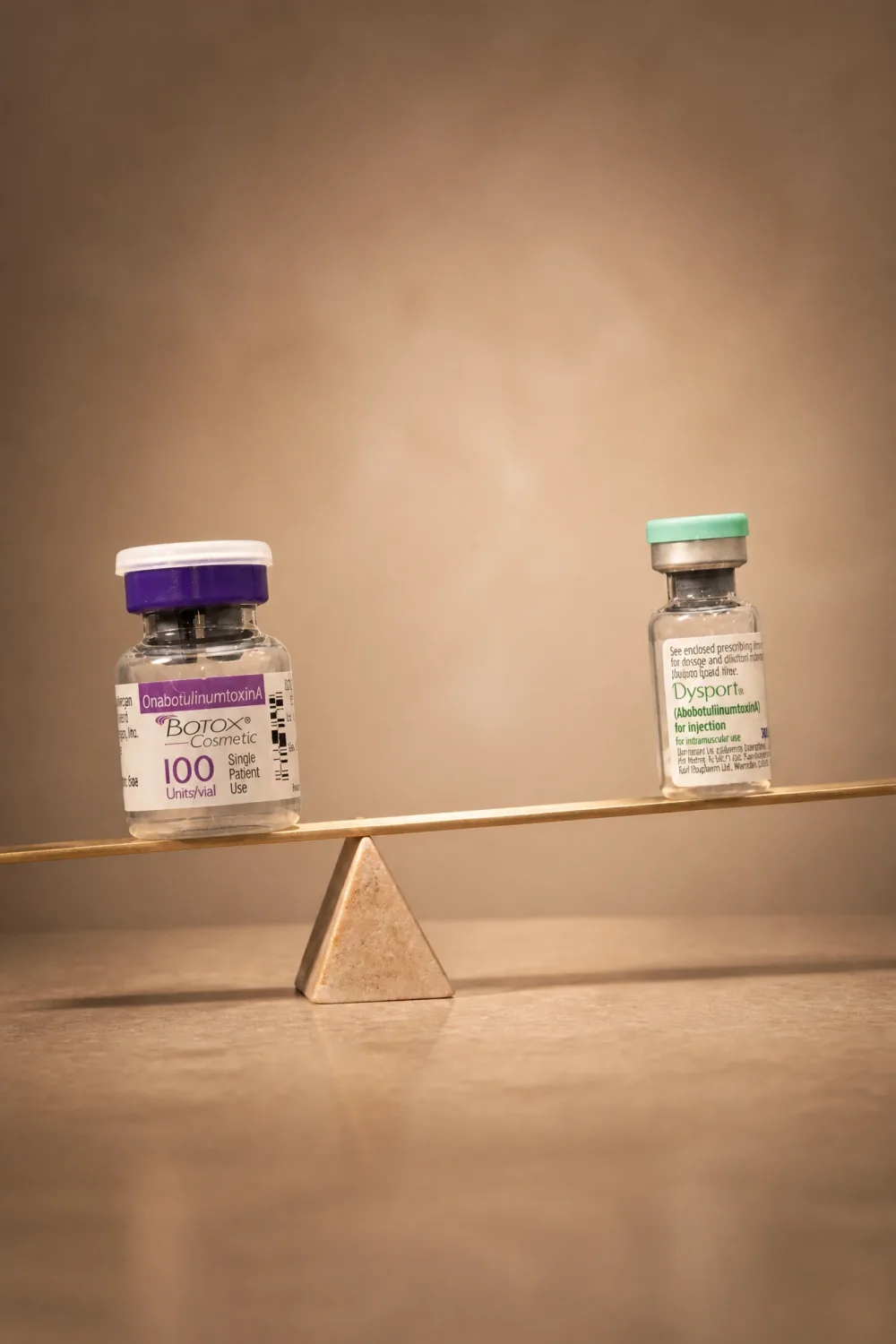
The neuromodulator relaxes that muscle temporarily. The muscle pulls less, so the skin creases less, so the line softens. It is an injection, given by our nurse.
Here is the part where the disappointment happens: the neuromodulator works on movement. It does not make skin firmer, it does not lift anything, it does not replace what has melted away. It calms a facial gesture, and that is plenty when the gesture is what bothers you.
Over the years, the fat pads of the face thin out and shift, and the bone itself remodels. The result: the temple hollows, the cheekbone flattens, the fold between nose and mouth deepens, the corner of the mouth drops.
The mechanism is easy to picture. When the support underneath shrinks, the skin that sat on top suddenly has too much surface for what it covers. It creases and it slides, not because it is tired, but because what it was covering got smaller.
Hyaluronic acid fillers put that material back where it is missing, and it is our nurse who places them. Done well, the result does not read as "a filled cheek": it reads as a face people find rested without knowing why.
Here too, we have to say what it does not do. Restoring volume does not tighten skin, and a face filled beyond its own volume does not look younger, it looks like someone else.
The third case is the sneakiest, because it does not come down to any one line. You cannot point at anything: the whole thing has moved. The jawline is less defined. The skin of the neck is softer. When you lean toward the mirror to put on makeup, everything drops a little more than it used to.
What changed this time is the weave of the skin. Collagen and elastin, the fibres that keep it taut, thin out and lose their order. The skin gets finer, looser, and gravity handles the rest.
No injectable repairs that weave. That is the job of energy: radiofrequency heats the deep dermis to tighten the collagen already there and restart production. That handpiece is not a nurse's by default, it is our medical esthetician's, and it is the procedure that matches what our facial laxity page describes.
And the honest limit, the one we tell you before we start: no energy device removes skin. When there is real excess, surgery is what gives the result, and we would rather say so at the first appointment than after a series of sessions.

You can do a first sort at home, in two minutes, with good side lighting.
This test does not replace an assessment, it gives you the vocabulary. Walking in saying "it only shows when I smile" or "it is there even when I am not moving" changes the whole conversation.
Back to the sentence we started with. Someone treats the upper face, loves the result on the forehead, and comes back six months later saying the lower face has not budged. That makes sense: the procedure addressed a forehead muscle, and what bothered her was the jawline, which is a matter of support and firmness.
The reverse happens too. We treat slackening skin with heat, the jawline sharpens, and the line between the brows is still there, because no device relaxes a muscle.
Nobody did poor work in either case. The sorting simply had not been done first. That is why we always start by looking, describing and naming before we propose anything.
Past a certain age, most faces show a bit of all three. The answer is not to do everything at once, and definitely not to do everything at the first visit.
What sets the order is not a package, it is two questions. What bothers you the most when you look at yourself? And what takes the longest to deliver its result?
That second question surprises people, and it is very useful. Filler shows right away. The neuromodulator settles in over a few days. Firmness rebuilds over weeks, because we are asking the skin to make collagen, and that cannot be rushed. When firmness is part of the plan, we often start it early, so time can work while we handle the rest.
This is not a cross-sell. Some people leave with a single procedure, others with a single piece of advice and an appointment a year out.
These three phenomena do not start together and do not move at the same pace. That is why at thirty-five and at fifty-five, the same person does not have the same conversation with us.
Expression lines show up first, because they depend on a movement you have always made: someone very expressive will see them early, even with perfectly healthy skin. Volume loss settles in later and more quietly, since nothing appears, something disappears. Laxity follows the gradual drop in collagen, and years of accumulated sun speed it up considerably.
One practical consequence: what bothered you five years ago is not necessarily what bothers you today. A plan that worked beautifully for years can stop being enough, not because it stopped working, but because a second phenomenon arrived on top of it. So we redo the sorting at every assessment, instead of renewing out of habit.
The law is clear in Quebec, and it is not an administrative footnote: it decides who you see.
Here, the assessment starts from what you see, not from whichever device is free. We tell you which layer your concern belongs to, what we are suggesting, what we are not suggesting, and why. You do not have to come and check: we say it upfront.
No. It temporarily relaxes a contracting muscle, which softens a movement line. It does not act on the fibres that keep skin taut. Slackening skin calls for a different procedure.
It can restore support where the face has emptied out, and that support changes how the skin falls. That does not make it a facelift, and on genuinely lax skin, adding more does not improve the contour. The assessment exists exactly to sort that out.
That is a question to ask before the session, not after. We ask at the assessment what you have had, where, and when, and that is where we decide how to proceed. Mention it even if it was a long time ago, and even if it was done elsewhere.
With whatever bothers you most in the mirror, keeping in mind that firmness takes longer to respond than injections. We set the order together, and nothing says everything has to happen in the same year.
Not necessarily. The injection is given by a nurse, the device is handled by a medical esthetician, and a nurse can hold the handpiece too. You will know who you are seeing before your appointment.
Naming the problem is not a vocabulary detail: it decides whether you will like your result. A movement line, a hollow and slackening skin are three different conversations, and a serious assessment starts by separating them.
If you have already walked away disappointed from a treatment elsewhere, it is worth saying so when you arrive. Nine times out of ten, that is where the explanation is.

Under the eye, it all depends on the type of line: there at rest, or only when you smile. A mirror test is often enough to tell.

The neuromodulator relaxes movement, filler restores volume. How we choose with you, without selling you both by reflex.

How a neuromodulator works, the difference between Botox and Dysport, the right time to start, and why a frozen look comes from dosing.
The best plan starts with an assessment. We look at your skin and answer your questions, no obligation.

Hi, I am Stella. Ask me about a treatment, a price or the clinic, and I will point you to the right place.
Stella answers from the site. She does not diagnose and does not book. The conversation stays 24 hours on this device, and the clinic keeps a copy.