Laser Hair Removal on Dark Skin: What Makes It Safe
On dark skin, the risk depends on the device and its settings. What wavelength changes, why Nd:YAG exists and what we check before your first session.

Many people call a spa's pulsed light a "laser". Here is the difference, why hair grows back with one of them, and how to spot a real clinic.

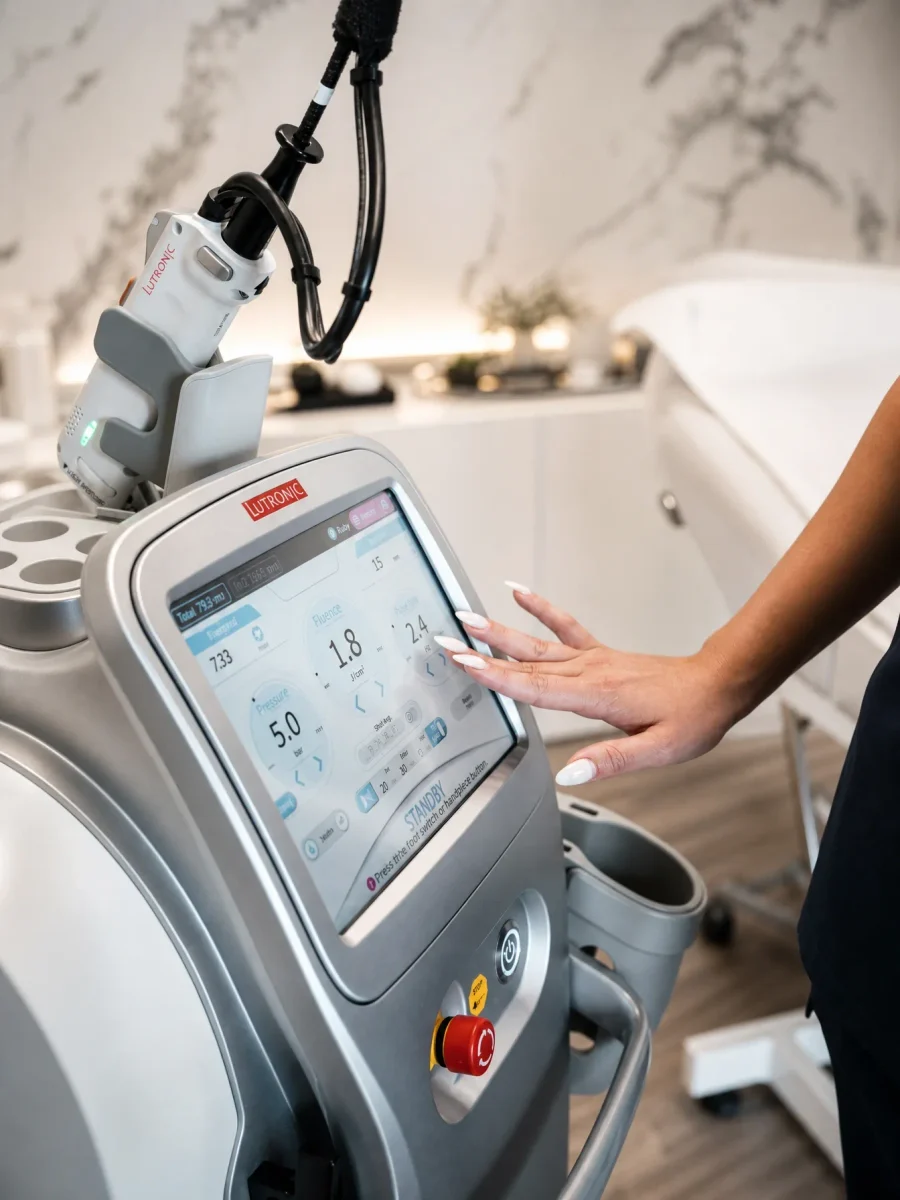
A medical laser sends one single light, well aimed, toward the root of the hair. Intense pulsed light (IPL) sends a mix of lights, scattered over the whole area. Both aim at the same thing, the hair's pigment, but the root isn't reached the same way. That's why hair grows back more often with IPL.
You may have seen "laser hair removal" at a spa, at a very low price. In many cases the device is IPL, and the word "laser" is just a sales name. It isn't the same technology. We explain the difference, which laser to choose, and how to recognize a real clinic.
A medical laser aims at the root of the hair. Pulsed light lights up the whole area.
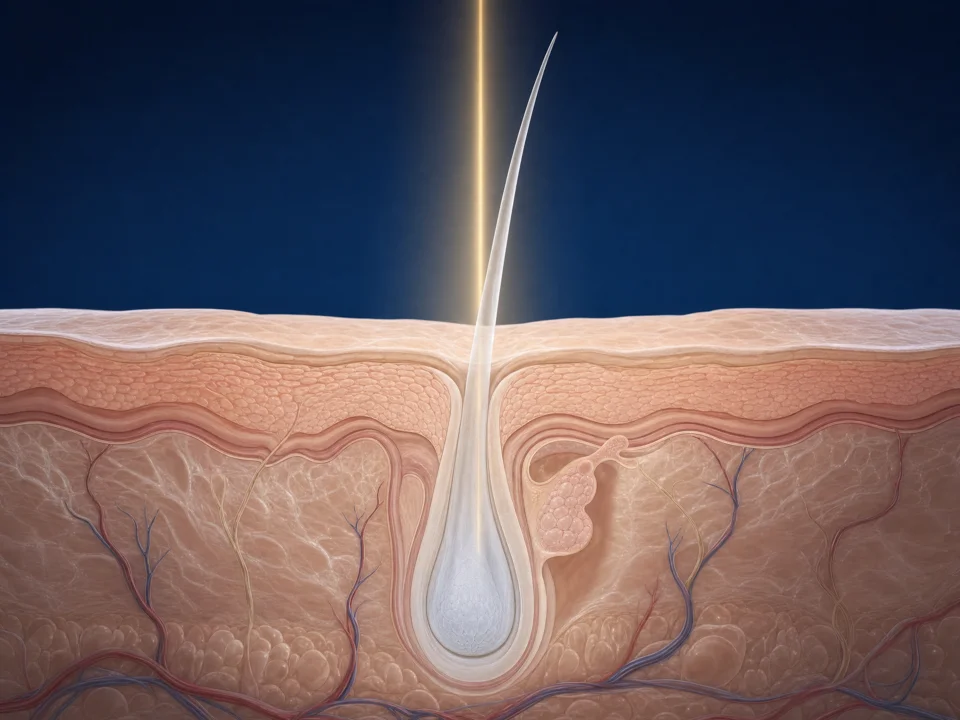
Every hair grows from a small pocket under the skin, the follicle. It's the root that makes the hair. A razor cuts what sticks out. As long as the root is there, the hair comes back.
Pigment is what gives hair its colour. Light passes through, gets absorbed, and turns into heat. The heat travels down to the root and weakens it. With no pigment, there's nothing to heat.
According to the Cleveland Clinic, dark hair holds a lot of pigment and so absorbs the most heat. That's why contrast matters: dark hair on lighter skin is the simplest case.
The difference is in the light itself. A laser emits a single wavelength (one "colour" of light), fired in one direction. IPL emits a mix of wavelengths that goes in every direction. Think of a laser pointer next to a studio lamp.
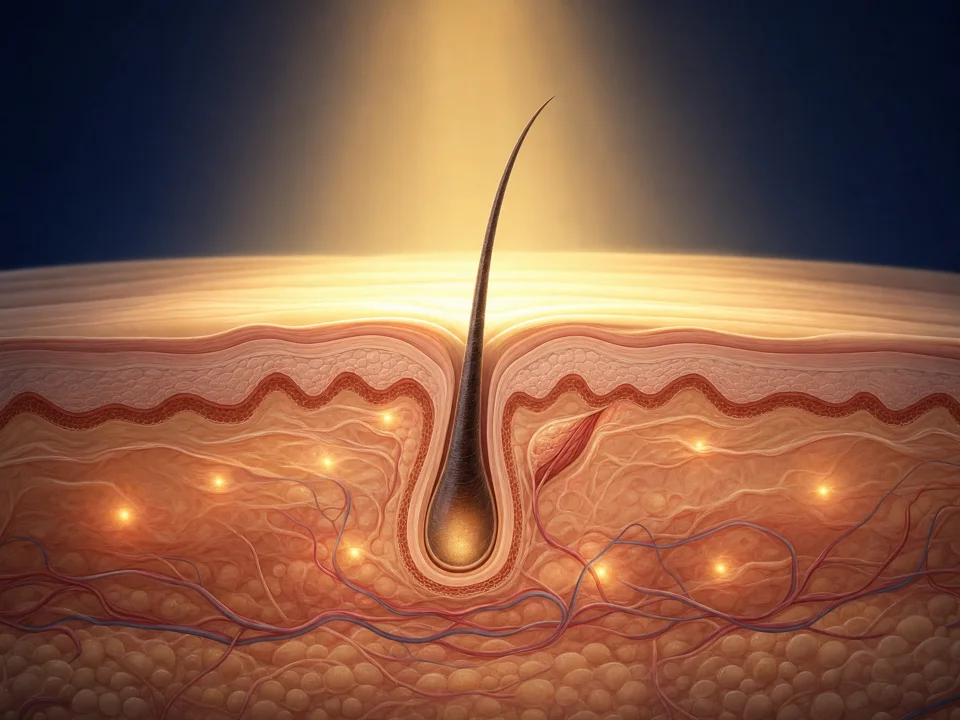
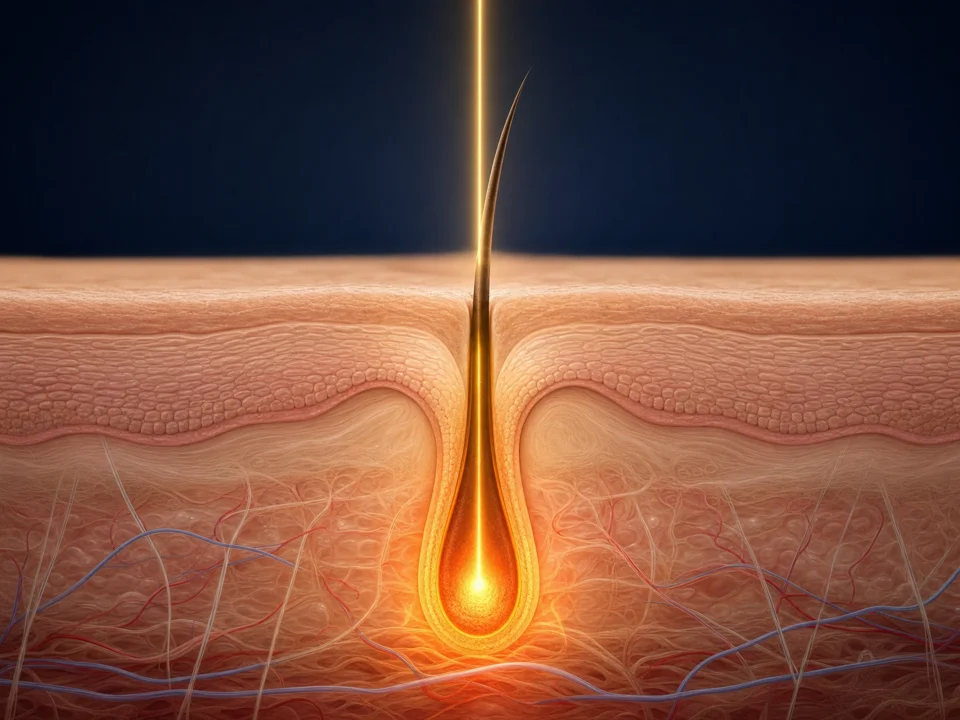
With a laser, nearly all the energy goes to the target. With IPL, part of it never touches the hair. It heats the skin around it, or misses.
| Medical laser | Pulsed light (IPL) | |
|---|---|---|
| The light | One single wavelength | A mix of wavelengths |
| Where the energy goes | Toward the root of the hair | Scattered over the area |
| Who uses it | A trained professional, in a clinic | A salon, a spa, or you, at home |
| The result over time | Lasting hair reduction | Reduction that takes more passes |
One session isn't enough with either. Hair grows in cycles, and a pulse only reaches hairs in full growth that day. You have to come back to catch the others.
At Clinique DC, with the laser, it's 8 sessions on average, four to six weeks apart. With IPL, it's more than 20 sessions, based on what we see at the clinic. It's an observed average, not a promise: the number changes with the area and with your hormones.
Cleveland Clinic, for its part, gives six to eight laser treatments. Figures vary from one source to another, which is normal: it all depends on the device, the area and the hair.
| If you stop midway | Laser | Pulsed light |
|---|---|---|
| Hairs already reached | Mostly don't grow back | Resume their cycle sooner |
| Hairs not yet reached | Come back | Come back |
| To keep the result | An occasional session is often enough | More regular upkeep |
The brand isn't what matters most. It's your skin tone and your hair colour, together.
When the skin is fair and the hair dark, the light goes straight to the hair. When the skin is medium or dark, it absorbs part of the energy itself: the risk is heating the skin instead of the root. A longer wavelength goes deeper while sparing more of the skin. That's why a laser with two wavelengths is better indicated for medium or dark skin. Our device, the Clarity II, has two: 755 and 1064 nanometres, according to the manufacturer.
| Your skin | Your hair | What works |
|---|---|---|
| Fair | Dark | Laser and IPL both respond well |
| Medium to dark | Dark | A two-wavelength laser; IPL is riskier |
| Fair or dark | Golden blonde, light brown, brown | Enough pigment: the laser works |
| Fair or dark | Very pale blonde or light red | Very little grip; it's checked at the assessment |
| Fair or dark | White, grey, platinum | No grip: with no pigment, nothing to heat |
A golden blonde hair still has enough pigment. A white hair has almost none. In both cases, it's the pigment that lets the heat travel down to the root.
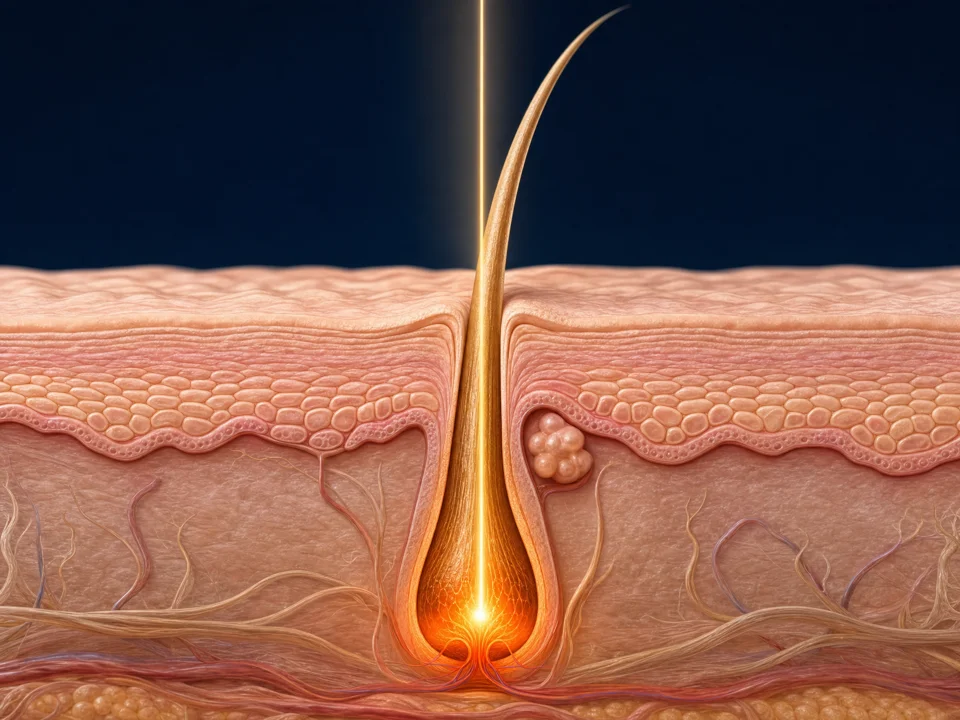
No device, laser or IPL, changes that: it's physics, not brand. According to the American Academy of Dermatology, laser doesn't work on blonde, white, grey or red hair. Here, a golden blonde hair can be treated, and we tell you at the assessment whether yours is dark enough. If not, electrolysis, which works hair by hair, remains the method that works.
A home device is also mostly pulsed light. According to the American Academy of Dermatology, you need to use it much longer to see results. The Cleveland Clinic adds that without supervision by an experienced person, the risk of misuse and injury goes up.
In a clinic, the person adjusting the device reads your skin before each session. At home, you're both the person being treated and the one adjusting, without having learned to read skin. It's also why these devices are limited in power.
| Sessions in clinic | Home device | |
|---|---|---|
| Who adjusts the device | A medical esthetician, who checks your skin and your hair | You |
| How you pay | A flat monthly rate, or per session | An upfront purchase, then refills |
| The rate | Doesn't change with the number of zones | Depends on how often you use it |
À la carte, a single zone starts at $40 per session. The Unlimited Zones plan costs $497/mo for women and $697/mo for men, taxes extra. It's the zones that are unlimited, not the sessions: one session a month, as many zones as you want. What it takes to qualify is written on the offer page. We don't know what home devices cost, so we won't give a figure.
Four things can be checked before you book:
Here, those four points are explained in detail, with names and photos, in our checklist guide. And if someone mentioned Soprano, the comparison with our laser is here.
A laser sends a single wavelength, aimed at the root of the hair. Pulsed light sends a mix of wavelengths, scattered over the area. As a result, more energy reaches the root with a laser, and less hair grows back.
You can ask for the device's name, and you should be given it without hesitation. The word "laser" on a sign proves nothing: many spas use it for pulsed light.
A laser with two wavelengths, one of them long, which spares the skin better. IPL is riskier on medium or dark skin. The right setting is chosen at the assessment, by looking at your skin.
Yes, it's common, if your skin and hair colour suit it. We assess your skin at the first visit, whatever you tried before.
It's felt a little more, like a rubber band snapping, because the energy is concentrated. The built-in cooling on our device greatly reduces the discomfort of each pulse.

On dark skin, the risk depends on the device and its settings. What wavelength changes, why Nd:YAG exists and what we check before your first session.

Laser targets the melanin in hair: without it, there is nothing to aim at. What electrolysis does instead, and how to split your body between the two.

An at-home IPL device removes about one hair in two, an in-clinic laser more than eight in ten. Why, for which skin, and when home is enough.
The best plan starts with an assessment. We look at your skin and answer your questions, no obligation.

Hi, I am Stella. Ask me about a treatment, a price or the clinic, and I will point you to the right place.
Stella answers from the site. She does not diagnose and does not book. The conversation stays 24 hours on this device, and the clinic keeps a copy.