Microneedling or Laser: What Actually Refines Skin Texture, Depending on Your Skin and Your Schedule
Two ways to restart collagen: tiny needles or laser light. What sets them apart, and which one suits your skin type and your schedule best of all.

Pitted acne scars do not respond to one technology alone. What we use in Sainte-Rose, who does the treatment, and what we do not promise you.

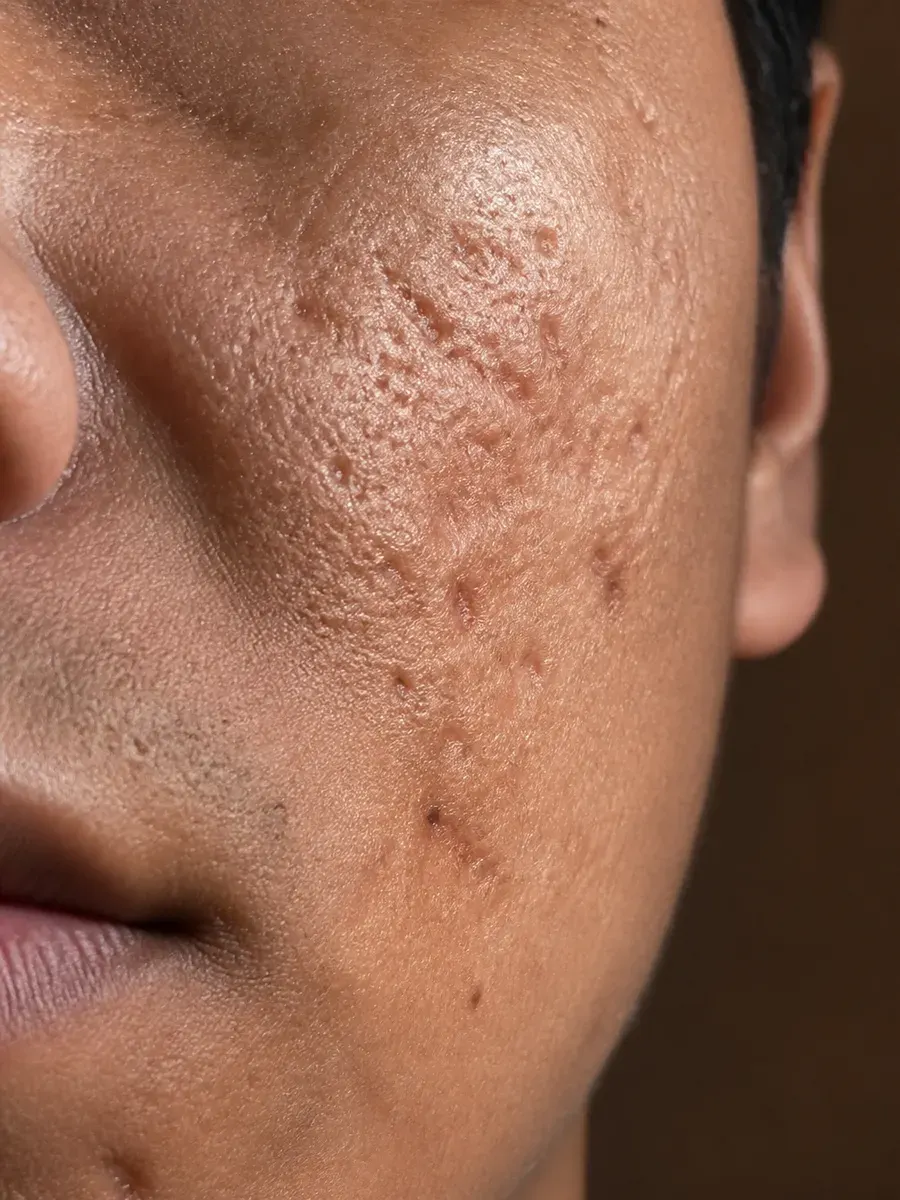
You are looking for where to treat your acne scars in Laval. The short answer: at Clinique DC, in Sainte-Rose, we work on pitted scars with microneedling, Potenza, or both depending on how deep they are, in series. We improve how they look session after session. We rarely get all the way to erasing them, and we tell you so before we start.
This article explains what a pitted scar is, why one session is never enough, what we use and why, who does the treatment, what it costs, and how the first visit works.
A pitted, or atrophic, scar is a small area where the skin lost collagen during acne inflammation. The surface sank, and the dip catches the light. That is why it looks deeper under bathroom lighting than outdoors.
There are also raised scars, where the skin made too much tissue. They are not treated the same way, and we tell them apart at the assessment. The acne scars page sums up both.
If you still have active acne, this is not the time to make scars the priority. Microneedling and Potenza are supporting treatments: they do not replace medical acne treatment. For moderate to severe acne, see your doctor first.
You may already have tried a single treatment and seen little difference. No reason to feel bad about it: that is the expected result.
What we do is restart collagen production under the dip. Collagen builds slowly, over weeks. One session starts the work, the series adds it up. That is also why we don't judge the result too early: between sessions, the skin keeps rebuilding.
The rhythm follows our treatment pages:
We don't promise a guaranteed total number of sessions. It depends on how deep your scars are and how your skin responds, and it becomes clearer as the series goes on.
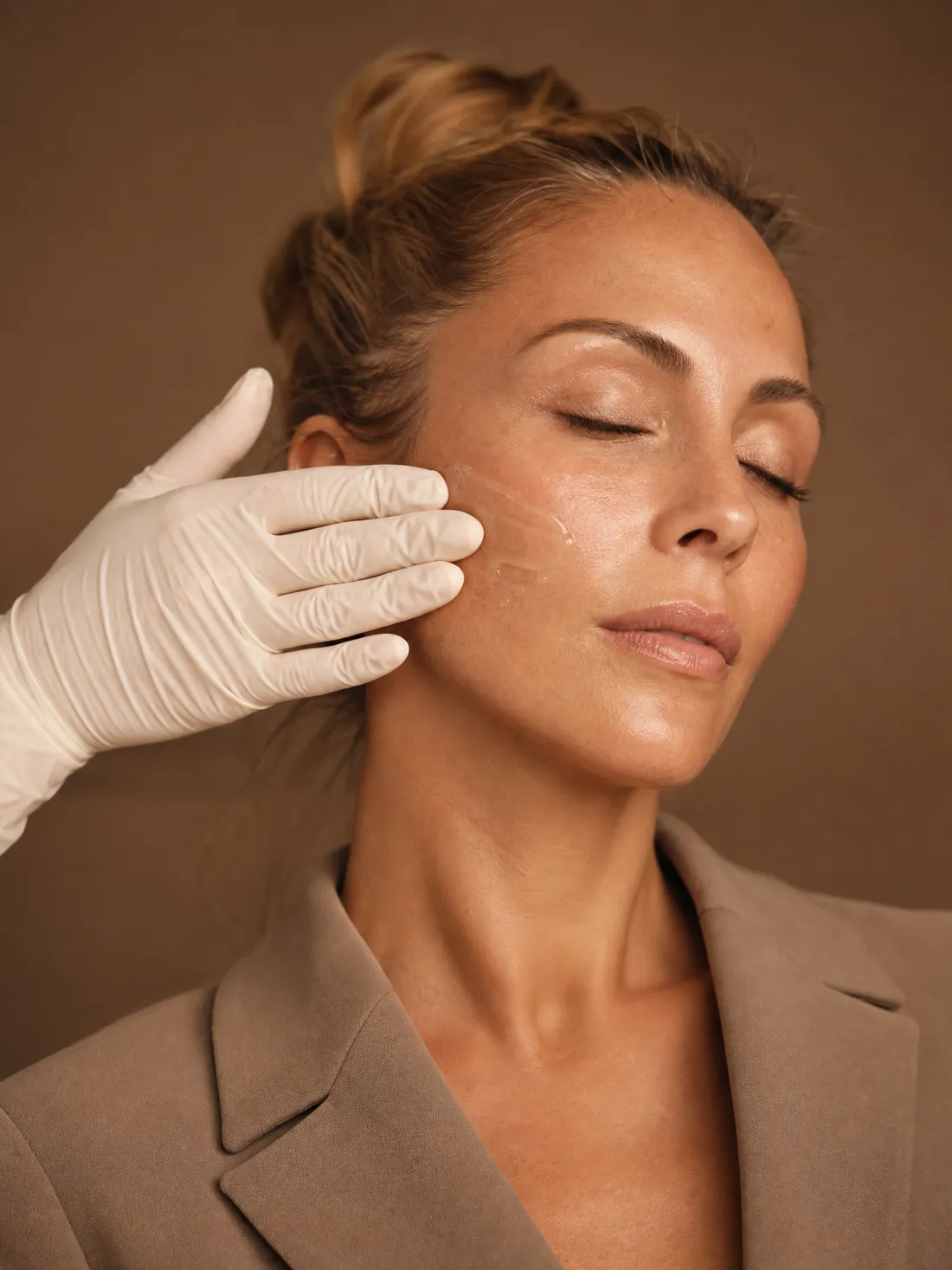
Both treatments start from the same principle: fine needles create controlled micro-injuries, and the skin responds by making collagen. The difference is in what gets added.
Microneedling works mechanically. The micro-channels trigger skin repair and let an active, chosen with you, absorb during the session.
Potenza adds radiofrequency heat at the tip of the micro-needles. That heat reaches deeper into the dermis and tightens tissue. It is the step up when the dips are deeper.
| What we see | What we often suggest | Why |
|---|---|---|
| Shallow dips, uneven texture | Microneedling | Restarts collagen near the surface, with short downtime |
| Deeper dips, skin that has also lost firmness | Potenza | The heat works deeper |
| Scars of different depths on the same face | Both, alternating | Each treatment targets a different layer |
| Raised scars | At the assessment | They are not treated like dips |
This table describes tendencies, not a prescription. The final choice is made in front of your skin, with the 3D analysis. The difference between the two treatments is detailed in microneedling or Potenza.
One clarification: neither microneedling nor Potenza is "needle-free". They are injection-free. Nothing goes under the skin through a syringe.
A question we hear often: wouldn't a laser do better? Two recent studies compared needle techniques with fractional CO2 laser, a device we don't have at the clinic.
In a trial published in 2024 in Dermatology Practical & Conceptual, nine people received microneedling on one side of the face and CO2 laser on the other, two sessions a month apart. Both sides improved, and ultrasound showed no significant difference between the two methods. Nine people is a very small group.
Other comparative trials favour the CO2 laser, at the cost of longer healing and more brown marks after treatment, especially on darker skin. No method wins on every count. The right one depends on your skin, your scars, and how much downtime you can afford.
Both sides of the face improved, and ultrasound showed no significant difference between microneedling and CO2 laser.
What we won't give you: an improvement percentage. The figures that circulate come from studies that are too small or from clinics selling a device.
Here is what you will know before your first session, without having to ask:
That last point matters more than you might think. When you look at yourself every day, you don't see a slow change. The starting 3D analysis is the point of comparison.

Here, microneedling and Potenza are done by a medical esthetician. She reads your skin at the analysis, chooses needle depth and intensity, and adjusts from one session to the next.
That means the person who assessed you is the one who treats you, and she follows how your scars change over the whole series. If an injection were ever added to your plan, a nurse would do it, never the esthetician.
The owner, Sarah-Donia Cherif, a clinical nurse, was a trainer for Cynosure Lutronic, the maker of Potenza, while she was already running the clinic.
The amounts come from the clinic's price list, before taxes:
| Treatment | Price | Note |
|---|---|---|
| Microneedling, per session | from $325 | Depending on the active chosen |
| Potenza, per session | $749 | Face |
| Potenza, 4-session package | $2,197 | Four sessions |
Taxes extra, on every line. These prices are posted on the Potenza and microneedling pages; we don't work "on quote". The number of sessions becomes clear at the assessment.
The first visit starts with an assessment including a 3D skin analysis. It is free and with no obligation: you are not committing to any treatment plan.
Here is what happens:
We also ask about your medications and current treatments. You tell us; the decision to stop one belongs to your doctor, never to us.
We won't tell you we are the only ones who do it well. Here is what you can check instead:
Rarely all the way. We get real improvement: the dips soften and catch less light. We tell you at the assessment so your expectations are right.
No total is guaranteed. Microneedling is every 4 weeks, Potenza every 4 to 6 weeks, and the number becomes clear as your skin responds.
Microneedling has no pigment criterion, and Potenza's radiofrequency does not target melanin. Your skin is still assessed at the visit, and the settings adapt to it.
That is your treating doctor's decision, not ours. Tell us what you take at the assessment; we adapt the plan to your situation.
Yes. The assessment with a 3D skin analysis is free and with no obligation.
Two ways to restart collagen: tiny needles or laser light. What sets them apart, and which one suits your skin type and your schedule best of all.

No magic number: microneedling is done in a series, at the pace your skin renews itself. What decides how many sessions you will really need.

Both prick the skin with fine needles, only one adds heat in the dermis. Which to choose for grain, pores, scarring or looseness, and where to start.
The best plan starts with an assessment. We look at your skin and answer your questions, no obligation.

Hi, I am Stella. Ask me about a treatment, a price or the clinic, and I will point you to the right place.
Stella answers from the site. She does not diagnose and does not book. The conversation stays 24 hours on this device, and the clinic keeps a copy.