Is the Unlimited Tattoo Removal Package Worth It? Who It Fits and Who It Doesn't
One fixed price per tattoo, every session for two years: from what size the package makes sense, and when paying per session is the better choice.

Touch-up, cover-up or removal: three paths depending on what really bothers you about your tattoo, and how to tell which one is truly yours.

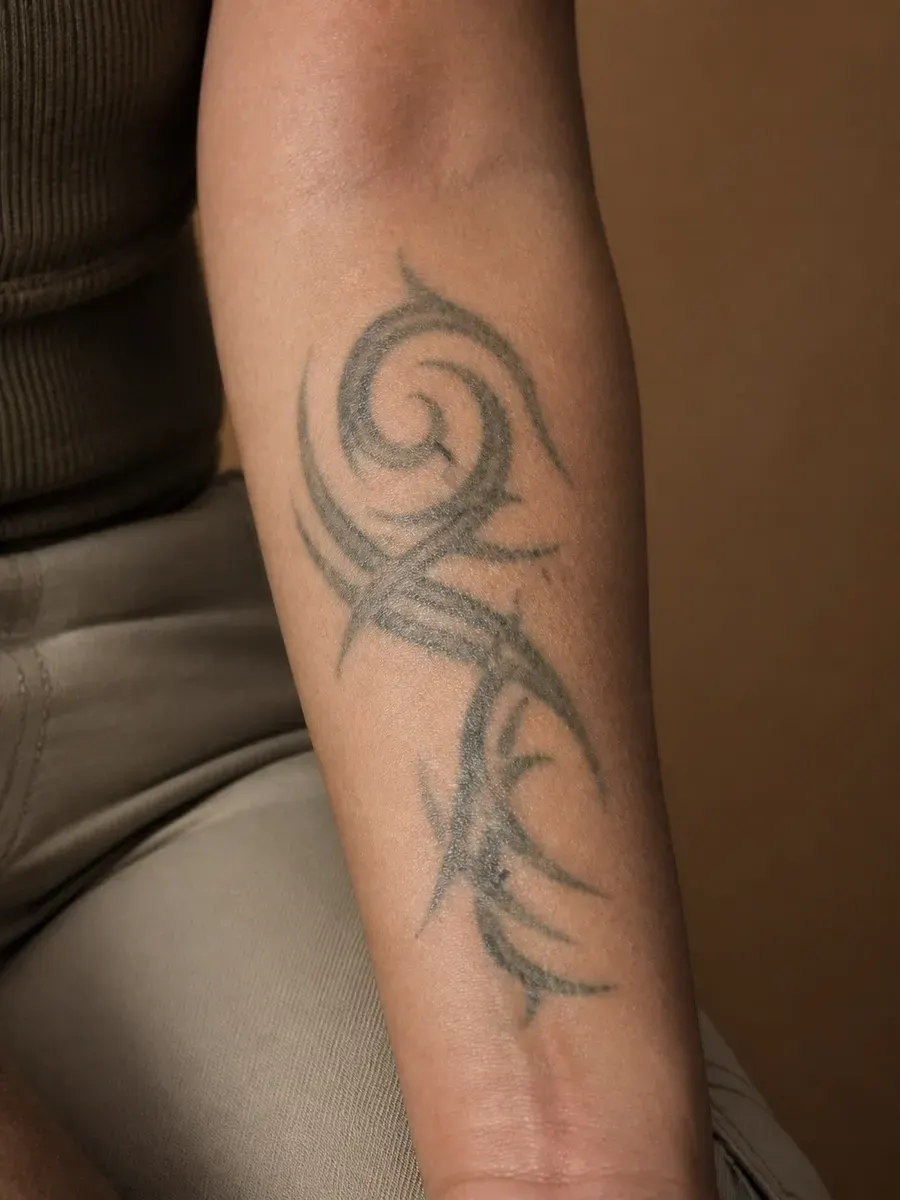
If you regret your tattoo, three paths exist: touch it up, cover it with another design, or remove it, partly or completely. The right choice depends less on the tattoo itself than on what bothers you about it.
You look at it in the mirror after a shower, you hide it under a sleeve in the summer, or you have simply stopped recognizing yourself in it. Nothing to be ashamed of: it's a common situation, and it has solutions.
This article helps you name what's wrong, walks through each option and what it takes, and ends with a grid to figure out which one is yours.
"I regret my tattoo" can mean four very different things. Before choosing an option, it's worth knowing which one is yours.
A survey of 196 people seeking tattoo removal at four American dermatology clinics (Armstrong et al., Archives of Dermatology, 2008) listed the reasons most often given: simply deciding to get rid of it, embarrassment, a body image that suffered, and a new job or career. The authors concluded that removal went along with a shift in identity, a way of distancing oneself from the past.
The survey only covers people who were already seeking removal. It doesn't say how many tattooed people regret their tattoo, so we won't give you a percentage. What it shows is that the reasons vary, and that they call for different answers.
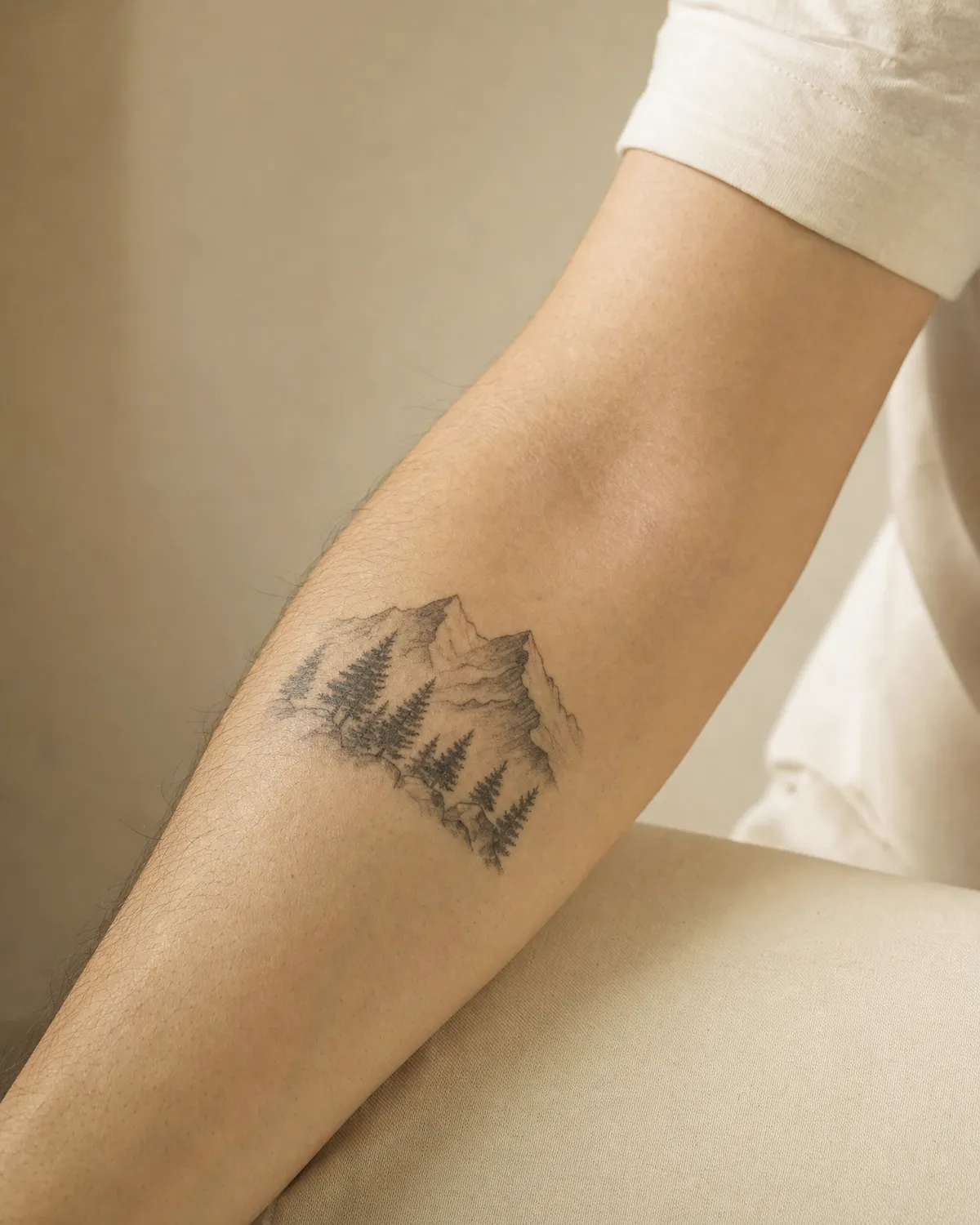
If it's the execution that bothers you and you still like the design, a touch-up is often the shortest path. A tattoo artist goes over the lines, fixes the shading, revives a colour that has faded.
A touch-up fits two situations well:
It doesn't fit when it's the design itself that no longer looks like you. Going over a motif you don't like anymore makes it more visible.
A touch-up is done by a tattoo artist. It's not a treatment we offer: if that's what suits you, we'll tell you plainly.
A cover-up means tattooing a new design over the old one. It's the option for people who still like being tattooed, just not with that motif.
A cover-up has a constraint people don't always see coming: the old ink stays in the skin, under the new design. The darker and denser the old tattoo, the less freedom the artist has for the new one. A light, fine or very detailed motif is hard to place over a dark base.
That's why a tattoo artist sometimes asks for the old design to be lightened before covering it. A paler tattoo underneath leaves more choice for the one going on top. We explain it in detail in our article on what to know before a cover-up.
It's up to the artist to judge whether your old tattoo can be covered as it is or needs lightening first. Their opinion comes before ours on that question.
When you don't want any tattoo at all in that spot, or when a cover-up needs lightening first, removal comes in. It's done with a laser, over several spaced-out sessions.
According to the American Academy of Dermatology, a laser cannot safely break down all the layers of ink in a single session. Your body also needs time to flush out the broken-up ink between sessions. The tattoo lightens after each session.
Removal comes in two forms:
It has to be said clearly: complete removal is never guaranteed. Cleveland Clinic notes that it's fairly common for removal not to clear a tattoo entirely, because some colours resist and some pigment sits too deep. The number of sessions, and what you can hope for with your tattoo, are discussed at the assessment, after we've seen it.
The right choice depends less on the tattoo itself than on what bothers you about it.
| What bothers you | The option that usually fits | What it takes |
|---|---|---|
| Poorly healed lines, uneven shading, but you like the design | Touch-up | An appointment with a tattoo artist |
| A tattoo that has faded or lost its sharpness, and that you still love | Touch-up | An artist willing to rework the existing design |
| A design you no longer like, but you want to stay tattooed | Cover-up | A new design, drawn by the artist to cover the old one |
| An old tattoo too dark to be covered as it is | Partial removal, then cover-up | A few laser sessions to lighten, then the artist |
| A meaning that has changed, and you want nothing in that spot | Complete removal | A series of spaced-out sessions, with no guarantee of full clearance |
| You're still unsure | Wait, and learn more | Nothing but time to think it over |
The same tattoo can fall into two rows. A name that means nothing to you anymore, on an otherwise well-done tattoo, can be covered as easily as removed: it all depends on what you want to see in that spot ten years from now.

Does regret fade with time? Sometimes. A tattoo that bothers you at 25 can become a memory you own at 40, and the reverse happens too. Nobody can tell you in advance which way yours will go.
What time doesn't change is the ink itself. A tattoo doesn't disappear on its own. It can fade and lose sharpness, which sometimes makes it easier to cover, but it stays.
If you're unsure, there's no rush. Waiting is an option in its own right, and it closes no doors: all three paths will still be open in six months. What we advise against is deciding in the heat of the moment, in either direction.
Two situations do call for a little more thought before acting:
Ask yourself three questions, in this order.
Sometimes people leave an assessment with the answer "keep it". A tattoo that barely bothers you, that's easy to hide, or whose removal would take more than you're willing to put in, doesn't always need treatment. We'll tell you that too.
One question remains once you've chosen your path: if it's removal or lightening, what will decide the number of sessions for your own tattoo? The page on unwanted tattoos answers that one.
Sometimes, and nobody can predict it. What doesn't go away is the ink: a tattoo can fade, but it doesn't leave on its own. Waiting remains an option that closes no doors.
If you still want a tattoo in that spot, a cover-up is often enough. It sometimes requires lightening the old design first, especially if it's dark. The tattoo artist judges whether the base works.
Yes. Partial removal lightens a tattoo without aiming to make it disappear. It can make it more discreet, or prepare a cover-up.
Yes, with a tattoo artist, if you still like the design. It's not a treatment we offer. A touch-up makes the tattoo more visible: it fits when you still love it, not when you want it to fade from view.
One fixed price per tattoo, every session for two years: from what size the package makes sense, and when paying per session is the better choice.
Laser before a cover-up gives the new design more room. How many sessions to aim for, what we don't promise, and what to tell your tattoo artist.
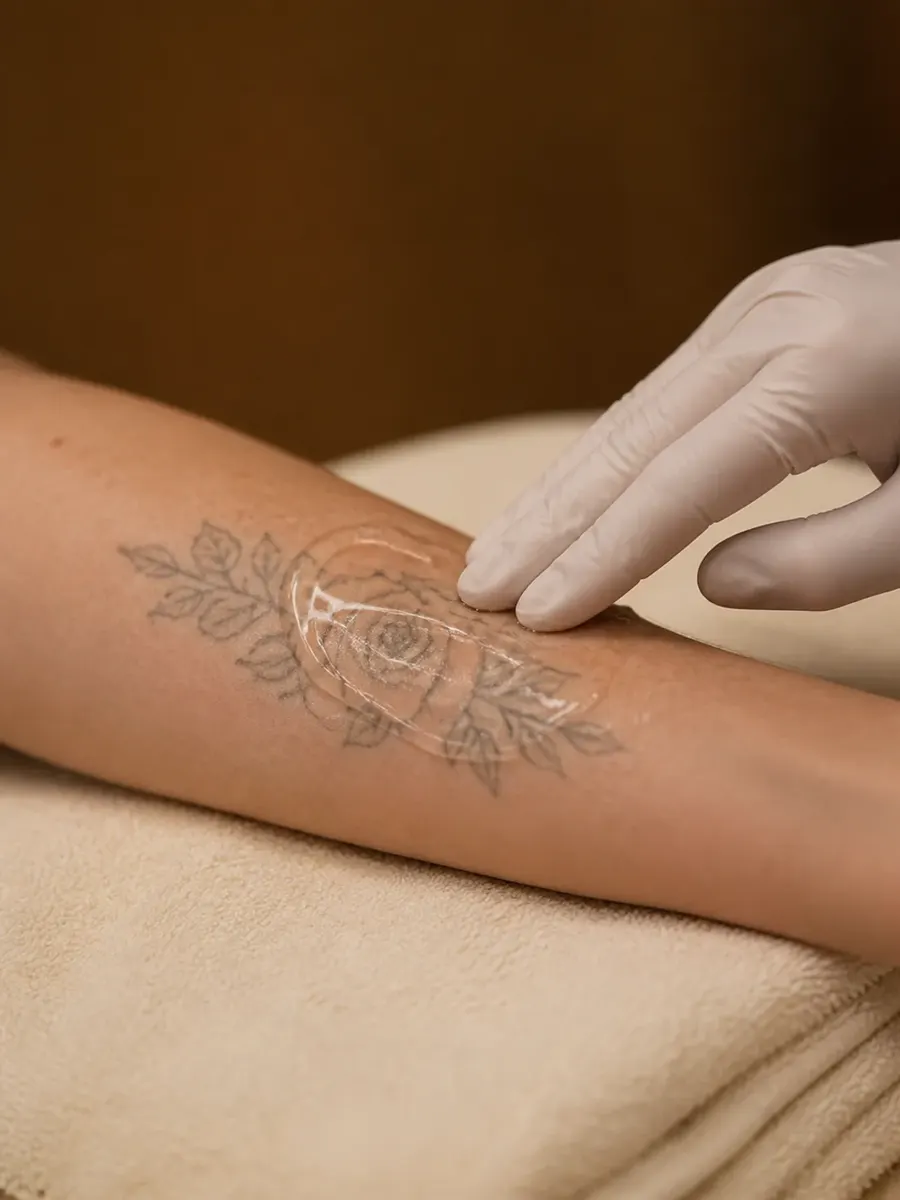
Regret a brand-new tattoo? Why we wait for the skin to heal before the first laser session, and how the date is set at your assessment.
The best plan starts with an assessment. We look at your skin and answer your questions, no obligation.

Hi, I am Stella. Ask me about a treatment, a price or the clinic, and I will point you to the right place.
Stella answers from the site. She does not diagnose and does not book. The conversation stays 24 hours on this device, and the clinic keeps a copy.