Receding Temples at 25: What You Can Do
Temples receding in your twenties? What the AAD says, what changes depending on the stage, and how DC Prime works while the follicle still responds.

So far, the safety profile of hair exosomes is reassuring. Where the product comes from, possible effects, and what is not known yet.

Are hair exosomes safe? So far, yes: their safety profile is reassuring, and the side effects reported are mild and brief. The approach is recent, though, and there's no very long-term data yet.
You're considering this treatment for denser hair, and you're hesitating because it's presented as something new. That's a normal worry. In fact, exosomes have been studied since the 2000s, and Korean aesthetic medicine was among the first to use them. Here's what's reassuring, what isn't known yet, and how we assess you. For how the treatment works, see DC-Exo.
The exosomes used in clinics contain no DNA. They're synthetic exosomal structures, with no genetic information that could interfere with your body.
They contain no living cells, which rules out immune rejection. Your immune system has no foreign body to fight.
They're synthetic, made in a laboratory under strict conditions; the product also contains plant stem cells (apple extract). They contain neither residual proteins nor transmembrane receptors, which is what makes them hypoallergenic.
Studies on plant-derived exosomes (not on the synthetic exosomes used at the clinic) describe good biocompatibility and a low immune response. No warning signal has been reported to date.
Two things to know before you decide. The exosomes used at the clinic are synthetic. And because the approach is recent, nobody has very long-term data yet. We'd rather you learn that here than somewhere else.
When there are any, they're mild and pass quickly:

Are exosomes safer than PRP? Both have a good safety profile. They simply avoid different risks.
No blood draw. So there's no needle in a vein and no risk of a vasovagal reaction, the faint feeling some people get at the sight of a needle or blood.
Consistent quality. Exosomes don't depend on how your health is on the day of the session, and the composition stays the same from one time to the next. PRP depends on your blood, and therefore on your habits.
A lighter procedure. The product is placed by microneedling or with a very fine needle, and you leave right away.
PRP does keep one advantage: it comes from you, and it has been documented far longer.
Your body already produces exosomes constantly to carry messages between its cells. The treatment brings in more of these messengers, as a purified product rather than a biological tissue.
Want to know where the product comes from and who makes it? Ask at your consultation. It's a normal question, and we're glad to answer it.
People it may suit:
Contraindications:
No need to sort through this alone at home. We go over the list with the nurse, your medications in hand.
| Treatment | Infection risk | Pain | Recovery |
|---|---|---|---|
| Exosomes | Minimal | Very low | Immediate |
| PRP | Minimal | Moderate | 24 to 48 h |
| Hair transplant | Moderate | High | 7 to 14 days |
A transplant remains the right option when some areas are completely bare. In that case it's chosen because it fits the problem, not for safety reasons.

No. These exosomes are synthetic structures, not living cells. Cancer arises from mutations in the DNA of dividing cells, and these exosomes contain neither a cell capable of dividing nor DNA that could mutate.
The risk is very low, because these exosomes don't contain the residual proteins that usually trigger a reaction, and they're produced under controlled conditions. We'll still ask about your allergy history before starting.
Yes. Maintenance means one to two sessions a year after the initial protocol.
No interaction is documented to date. Still, tell us everything you take: that's for the nurse to judge, not an article.
We don't start any treatment without looking at your file. Here's what you have on our side:
Exosomes have a good safety profile, and they avoid several of PRP's constraints. Both are good options, each with its own advantages.
We won't tell you exosomes are "the safest solution," because the data doesn't allow us to say so. We can tell you what we observe, what studies report and what's still missing.
To place your case, start with our hair page.

Temples receding in your twenties? What the AAD says, what changes depending on the stage, and how DC Prime works while the follicle still responds.

Hair that falls out after childbirth usually grows back by itself. When to worry, what we check, and what DC Bloom can do if it doesn't.
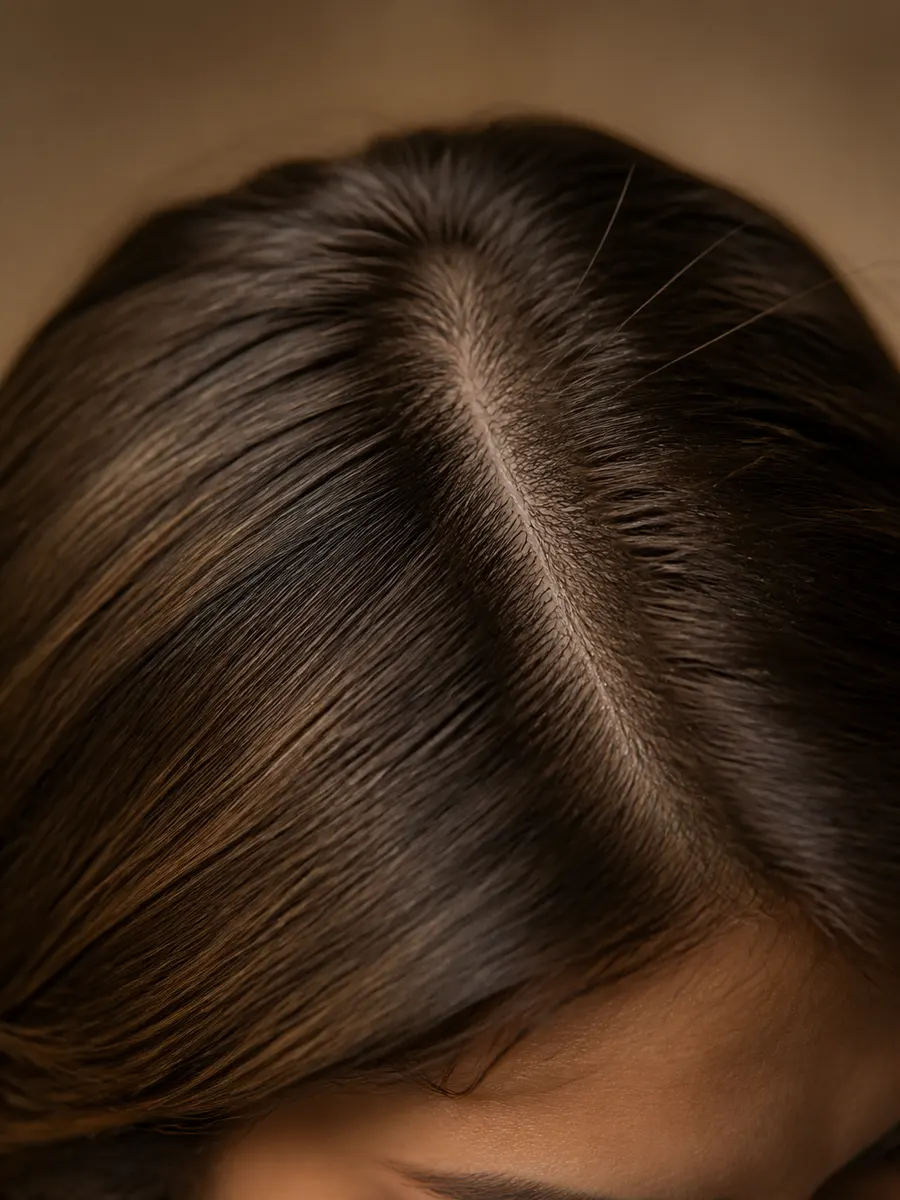
Why combine PRP and exosomes in one hair protocol, how the session goes, and our programs that bring both together.
The best plan starts with an assessment. We look at your skin and answer your questions, no obligation.

Hi, I am Stella. Ask me about a treatment, a price or the clinic, and I will point you to the right place.
Stella answers from the site. She does not diagnose and does not book. The conversation stays 24 hours on this device, and the clinic keeps a copy.