How laser hair removal actually works (and who it works on)
How the laser targets hair, who it truly works on, and what to expect session after session. No inflated promises.

Laser and IPL don't target hair the same way. What each can do, what it can't, and which skin tone it suits, without selling you the one we happen to offer.
You searched "laser hair removal" and "IPL hair removal" turned up almost as often. Both promise to free you from the razor. One site tells you the laser is stronger, another sells the convenience of a device you use at home. Nobody clearly tells you who each one is really for.
Here is the difference, without selling you the one we happen to offer: we work with the laser, so let's say this upfront. IPL is not a bad choice. It is a different choice, one that fits some situations and not others, in the same way the laser has its own limits.
Laser and intense pulsed light (IPL) aim at the same thing: the melanin in the hair, the pigment that gives it colour. Light energy passes through the skin, gets absorbed by that melanin, turns into heat and weakens the follicle that produces the hair. So far, the two look alike.
What separates them is the nature of the light itself. A hair-removal laser emits coherent, monochromatic light: one precise wavelength, fired in a single direction, with energy concentrated on that wavelength. IPL emits a broad spectrum, a mix of several wavelengths scattered in many directions, a bit like a photo studio's light box compared to a laser pointer.
That physical difference explains almost everything that follows: the precision, the strength of each pulse, and why one stayed mostly in clinics while the other became common in salons and bathrooms.
| Criterion | Professional laser | IPL (pulsed light) |
|---|---|---|
| Type of light | Monochromatic, one wavelength | Broad spectrum, several wavelengths |
| Precision per pulse | Energy concentrated on the target | Energy spread across a range of colours |
| Who usually operates it | Trained professional, medico-aesthetic setting | Salon, spa, or yourself at home |
| What it gives over time | Lasting hair reduction | Reduction, which often needs more upkeep |
The line worth remembering: a laser is precise because it only carries one wavelength. IPL does similar work with energy spread across a whole spectrum, so part of that energy never reaches the target at all.
Neither laser nor IPL actually see hair. Both see melanin, and that is where your skin tone and your hair colour come in together, not separately.
On fair skin with dark hair, the contrast is sharp: the light finds its target easily without overheating the surrounding skin. On medium to dark skin, the skin's own melanin absorbs some of that energy too, raising the risk of heating the skin instead of the follicle. That's why a single-wavelength device, tuned for fair skin, becomes risky on a darker skin tone: the longer Nd:YAG wavelength reaches the hair deeper while sparing more of the skin, while a broad light struggles to make that distinction.
| Skin tone | Hair colour | What works |
|---|---|---|
| Fair | Dark | Both laser and IPL respond well |
| Medium to dark | Dark | A dual-wavelength laser (with Nd:YAG) is better indicated; IPL is riskier here |
| Fair or dark | Blonde, red, light | Little response either way |
| Fair or dark | White or grey | No response: with no melanin, there's nothing to target |
That last line deserves to be said plainly, because no ad brags about it: neither laser nor IPL has any grip on white, grey, blonde or red hair. It's a limit of light itself, not a flaw of one particular device. We would rather tell you before your first session than after your third.
Here is what most comparisons leave out: the name of the person adjusting the device matters more than the name of the technology.
A professional laser carries more parameters to adjust (wavelength, pulse duration, energy, cooling) than most consumer IPL devices, which are simpler and more limited in their settings. That flexibility is a strength in trained hands, hands able to read a skin tone and adjust the shot accordingly. It only holds value if someone uses it with that judgment.
Here, it's a medical esthetician who holds the handpiece, never improvised. Before your first session, we establish your skin tone and look at your hair colour: that's what sets the settings, not a box checked at random. You know who is treating you before you even step into the room, because it's a question we would rather answer in advance than wait for you to ask.
An at-home IPL device removes that step. You become both the person being treated and the person adjusting the device, without years spent learning to read skin. Manufacturers have capped the power of these devices for that exact reason, which partly explains why they ask for more patience to reach a comparable result.
Neither method clears hair in one session. The follicle follows a cycle, and one pulse only reaches the hairs that are in their active phase right then. You need to come back, several times, to catch the hairs that were dormant the time before.
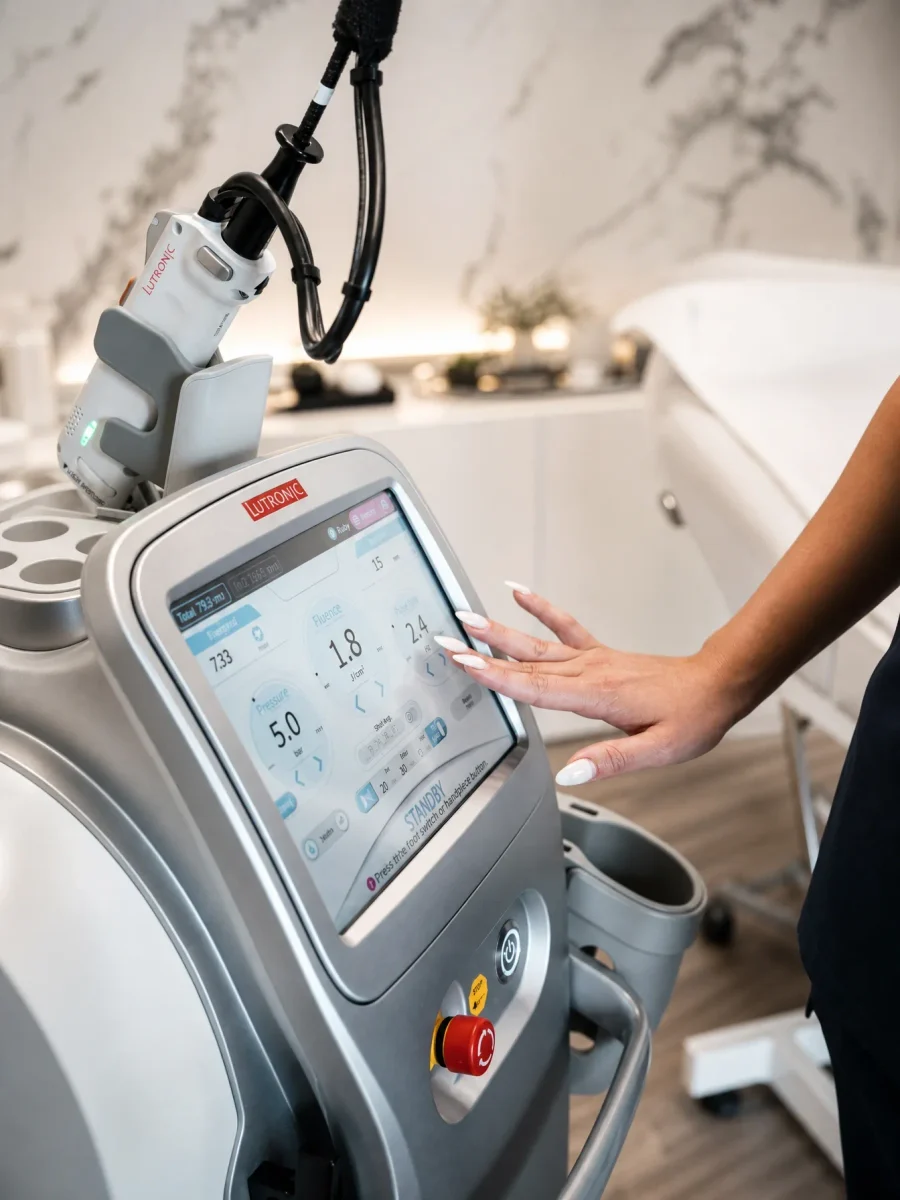
Here, with the Clarity II laser, the average course runs around eight sessions, spaced four to six weeks apart. That pace follows the hair's cycle, not a scheduling convenience: it's an order of magnitude we see in clinic, not a numbered promise, and your hair growth, your hormones and the area treated all move that number.
For IPL, the logic is the same but the calendar stretches further: because each pulse is more diffuse and so less concentrated on the follicle, it generally takes more passes to reach a comparable effect. We won't give you a precise figure here, because no reliable source fixes one and it varies too much from one device to the next.
| Laser (in clinic) | IPL | |
|---|---|---|
| Pace between sessions | About 4 to 6 weeks, to follow the hair's cycle | Similar, often closer together on home devices |
| If you stop midway | Treated hairs mostly don't grow back; hairs not yet reached return | Hair that didn't receive enough energy resumes its normal cycle sooner |
| Long-term upkeep | An occasional session is often enough to keep results | More regular upkeep is generally needed |
A clinic plan and an at-home device don't compare on a single number: they are two different economic models.
Here, the logic isn't to bill every zone by the session. À la carte, a single zone starts at $40 per session. The Unlimited Zones plan, on the other hand, is a flat monthly rate that covers every zone in the same session: $497 a month for women, $697 a month for men, taxes extra. It is the zones that are unlimited, never the sessions. One session a month, as many zones as you want in it. What it takes to qualify is written on the offer page.
An at-home device follows a different model: an upfront purchase, then replacement cartridges or refills over time, with no supervision and no adjustment of the setting to your skin. We don't know the real cost of these devices or their cartridges, so we won't hand you a made-up figure here.
| Clinic plan | At-home device | |
|---|---|---|
| How it's billed | A flat monthly rate, or à la carte by session | An upfront purchase, then cartridges to replace |
| Who adjusts the device | A medical esthetician, skin tone and hair checked at every visit | You, session after session |
| What changes year to year | The rate stays the same, no matter how many zones | Cartridge cost depends on how often you use it |
What we can tell you without a made-up figure is what the at-home model implies: you alone carry the decision about the setting, session after session, on hair growth that shifts with the seasons and your hormones.
Honesty runs both ways. The laser has its own limits too, and here they are, plainly.
It does nothing on white, grey, blonde or red hair, as said above, and that isn't about to change: it's a matter of physics, not device generation. It asks for a commitment of several months, not a result in one visit. And it costs more upfront than a home device, even though that cost then spreads across unlimited zones rather than a single one.
If your hair is light or white, neither laser nor IPL will give you what you're after. In that case, electrolysis remains the only option that works, hair by hair, even though it's slower. We would rather point you toward what actually works than sell you a series of sessions that won't deliver.
We don't guess which technology suits you from a blog article, and we don't sell you an IPL treatment we don't offer either. What we do is look at your skin tone and your hair colour at the very first meeting, before proposing anything.
If laser suits you, the next step happens in consultation, with the Unlimited Zones plan if you're aiming for several areas. If your situation calls for another method, we tell you plainly, rather than keeping you in a series that won't give what's needed. We explain how the laser works in detail in this article, and the facts on melanin, skin tone and hair colour live on our page about unwanted hair.
It works, within what it can target: mainly a fair skin tone with dark hair. The reduction holds over time, but it usually needs more consistency than a professional laser, because each pulse is more diffuse. It isn't temporary magic, it's simply a less concentrated technology.
The main risk isn't the technology itself, it's the lack of a trained eye reading your skin before every pass. A poorly assessed skin tone, a device set too strong on tanned skin, or used on an area that doesn't tolerate it: these are setting errors, not flaws specific to IPL. It's exactly the same logic behind establishing your skin tone before your first session in clinic.
Yes, and it's a common situation. If IPL hasn't given you what you were after, laser remains an option, provided your skin tone and hair colour suit it. We assess your skin at the first meeting, regardless of what you tried before.
Because it concentrates its energy on a single wavelength, exactly on the target: the sensation is sharper, like a rubber band snapping. IPL spreads its energy across a wider spectrum, so the feeling is often gentler, but that same spread is what makes it less precise and less lasting. The built-in cooling on our device greatly reduces the discomfort of each pulse.
Here, it's a medical esthetician trained on the Clarity II who performs the treatment, from start to finish of your course. You know who is treating you before you step into the room, without having to ask.
How the laser targets hair, who it truly works on, and what to expect session after session. No inflated promises.

We’re in Sainte-Rose, Laval, right next to Montreal. Dual-wavelength laser for every phototype and an Unlimited Zones plan. What sets us apart.
The best plan starts with an assessment. We look at your skin and answer your questions, no obligation.

Hi, I am Stella. Ask me about a treatment, a price or the clinic, and I will point you to the right place.
Stella answers from the site. She does not diagnose and does not book. The conversation stays 24 hours on this device, and the clinic keeps a copy.