Receding Temples at 25: What You Can Do
Temples receding in your twenties? What the AAD says, what changes depending on the stage, and how DC Prime works while the follicle still responds.

Exosomes are tiny cellular messengers. How they act on your follicles, explained in plain language and with no promise of results.

How do exosomes act on hair? They're tiny vesicles, a kind of messenger your cells send one another to communicate. In hair treatment, we place them in the scalp so they carry a signal to stimulate scalp activity.
You've heard of them, but the word stays vague, and it's hard to judge a treatment you don't understand. This article explains what is known about the mechanism, without guaranteeing a result. The exosomes used at the clinic are synthetic.
An exosome is a vesicle, meaning a tiny biological sac, measuring between 30 and 150 nanometres. That's about a thousand times smaller than the thickness of a hair.
Every cell in the body produces them naturally. It's how cells communicate, a bit like letters they send each other to exchange information.
What an exosome contains:
The ones we use at the clinic are synthetic exosomes, made in a laboratory. Permitted sources vary from one country to another. You're welcome to ask where the product comes from at your consultation.
The manufacturer describes a synthetic exosomal structure, with PDRN, hyaluronic acid, biomimetic peptides, plant stem cells (apple extract) and vitamins.
You can think of exosomes as small messengers sending a signal to stimulate scalp activity. It happens in three steps.
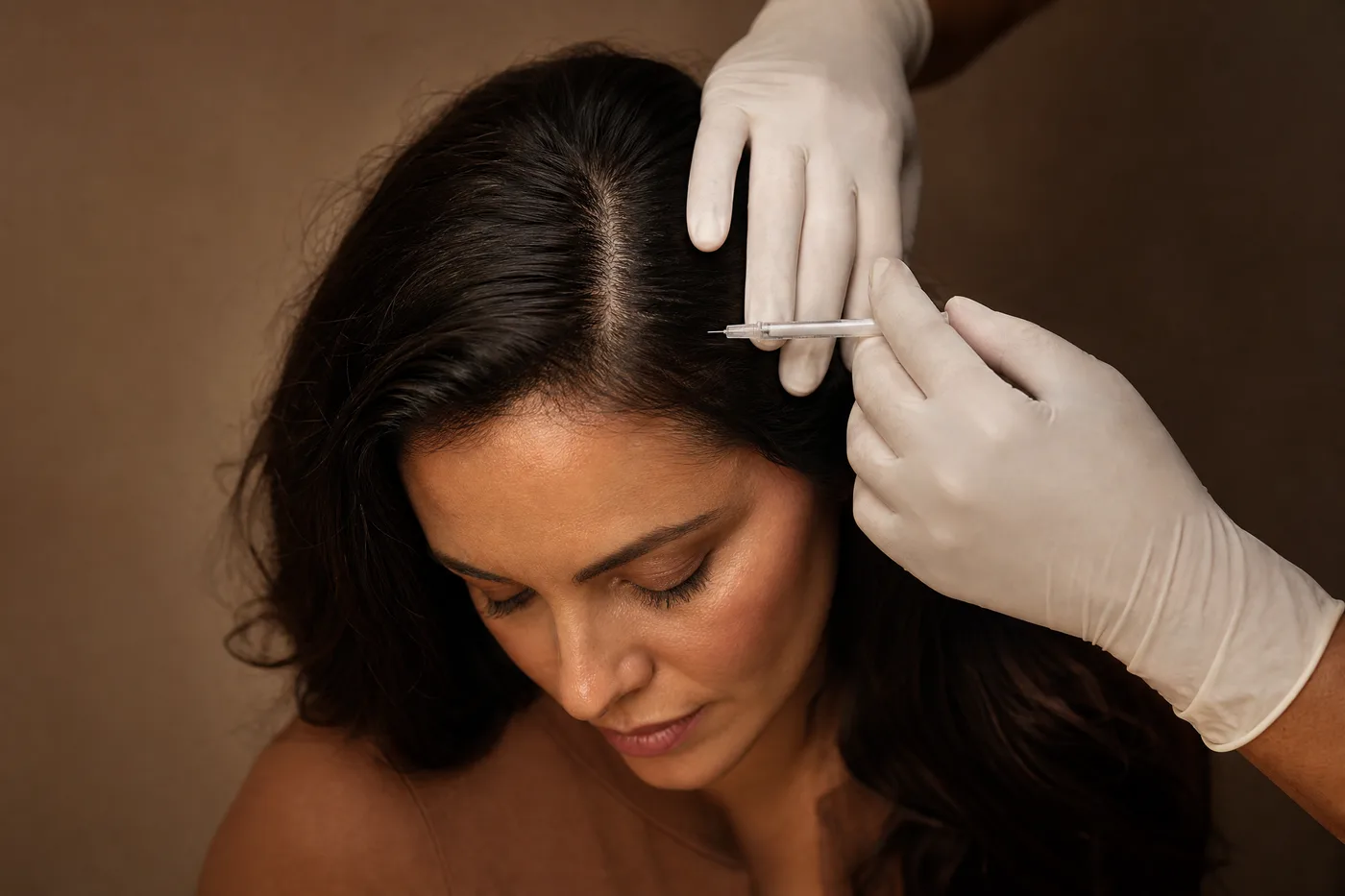
Exosomes are placed directly in the scalp, through micro-injections with a very fine needle or through microneedling, depending on the protocol.
Why we go that way:
Once placed, exosomes fuse with the membrane of your follicular cells, a bit like a letter slipped under a door.
The message they pass on to the cell:
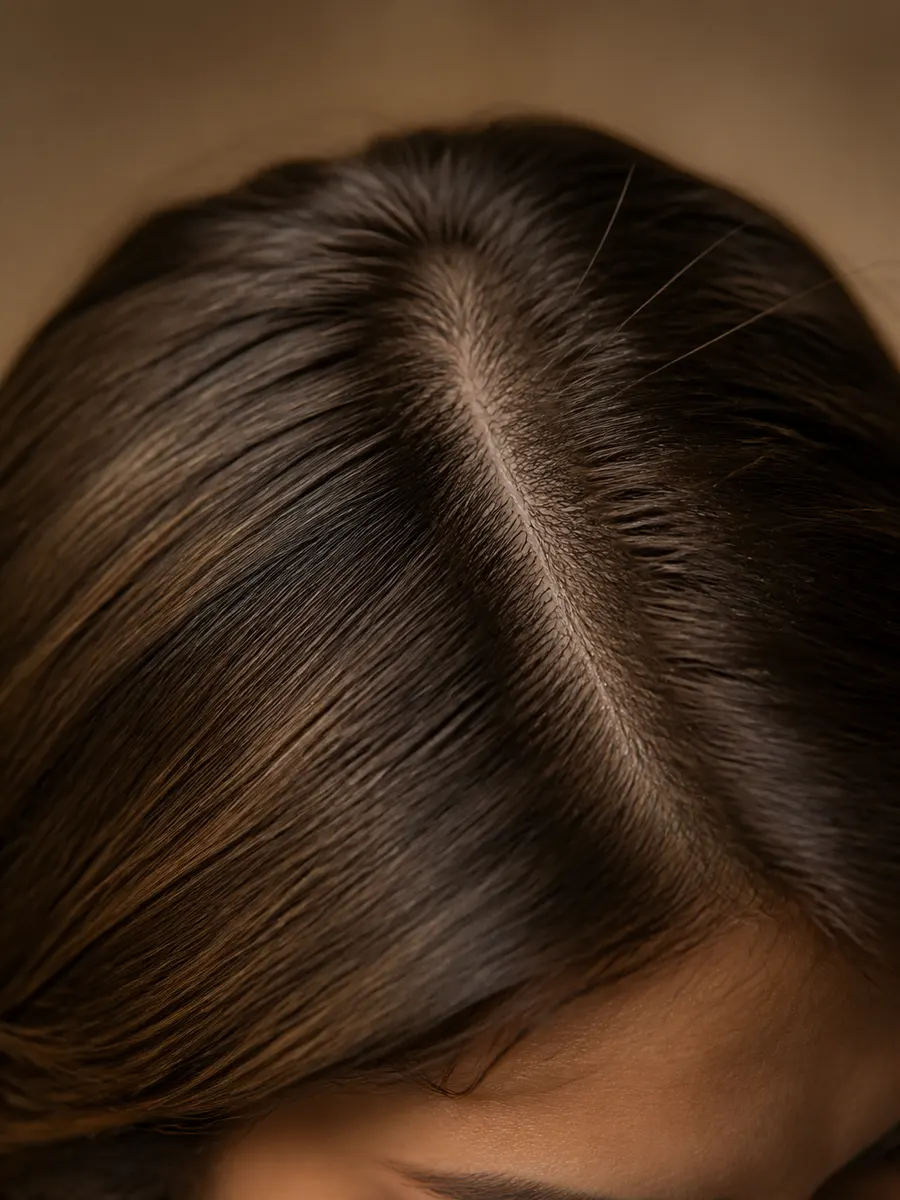
The scalp receives a signal that stimulates its activity, and hair looks thicker. Results vary.
The environment around the follicle improves, with less local inflammation, better microcirculation and a stronger follicular matrix.
A longer growth phase. Exosomes encourage the hair to stay in the anagen phase longer, which means longer, stronger hair.
A shorter resting phase. They reduce time spent in the telogen phase, and turnover speeds up.
A cleaner transition. The shift between growth and rest, the catagen phase, happens more smoothly, and fewer hairs fall too early.
In the scalp, cells exchange messages constantly. The follicle signals to the dermal papilla that it needs more nutrients to grow, and the papilla asks the blood vessels to increase blood supply to the area.
At the same time, stem cells get the signal to multiply faster to produce more keratin, and fibroblasts the signal to strengthen the collagen that supports the follicle.
Chronic scalp inflammation is one of the causes of hair loss. It weakens the follicle little by little, without anyone noticing.
What exosomes bring to it:
| Feature | Exosomes | PRP |
|---|---|---|
| Source | External, cell cultures | Internal, your own blood |
| Blood draw | None | One draw required |
| Consistency | Standardized session to session | Varies with your health |
| Concentration | Consistent from one session to the next | Depends on your platelets |
| What makes it vary | Very little | How you are doing that month |
The two combine well, and that's the basis of our DC Bloom Exo and DC Prime Exo programs.
Minoxidil dilates blood vessels at the surface and treats the symptom. When you stop, shedding returns.
Exosomes act on the follicle itself and its environment, not just on the shedding you can see. Their effects hold with maintenance.
Minoxidil is a matter for your doctor; our programs are another option.
A hair transplant addresses completely bare areas. It redistributes existing hair and gives an immediate result, but a fixed one.
Exosomes improve the overall quality of the hair. They act on the follicles still present and slow the loss to come.
Do you have completely bare areas? Then a transplant is the right answer, and we'll tell you so.
The markers below describe a typical progression. Response varies from person to person, and nobody can guarantee you a result.
Around 1 month. Daily shedding drops, and hair becomes shinier and more resilient. Texture improves too.
Around 3 months. Fine hair looks thicker and the hair looks denser. Results vary.
Around 6 months. The change shows across the whole head of hair: hair looks fuller. Results vary.
Around 12 months and beyond. Results settle and the hair cycle is rebalanced, which slows further loss.
Androgenetic alopecia. Hair looks thicker where the follicles are still present. Results vary.
Diffuse loss in women. Hair looks thicker and fuller. In women, we first check iron, thyroid and hormones, because a follicle restarted without correcting the cause keeps fighting against it.
Telogen effluvium. Recovery is faster and the shedding phase shorter.
Alopecia areata. This is an autoimmune condition, followed in dermatology. We don't treat it here, and we'll refer you.
1. When plasma quality would be lower. That's the case with smoking, chronic stress, disrupted sleep or an unbalanced diet.
2. When your health rules out PRP. For example poorly controlled diabetes, anticoagulants or certain chronic conditions.
3. When you want to avoid the blood draw. Some people simply don't want one, and that's reason enough.
Your lifestyle and health directly influence the quality of your PRP. Exosomes always arrive at the same concentration, and it generally exceeds what a standard PRP delivers.
There are practical reasons too. No blood draw, a shorter session and fewer variables to control.
1. Preparation, about 10 minutes. We clean the scalp, apply numbing cream if needed and prepare the exosomes.
2. Placement, 15 to 20 minutes. We make precise micro-injections in the targeted areas, at follicle depth. With a very fine needle, discomfort stays mild.
3. After, 5 minutes. A gentle massage spreads the product. We then give you the aftercare instructions and the date of the next session.
The starter phase, with our DC-Exo program. A series of sessions a few weeks apart, with follow-up on the first signs and no blood draw.
The maintenance phase. One to two sessions a year as needed, to hold what has been gained. We adjust it as things evolve.
Your habits. A diet rich in protein and vitamins, sleep, and less stress where possible. Treat your scalp gently too.
Complementary treatments:
There's no risk of rejection, the product is prepared under sterile conditions, and side effects are mild and brief.
What you might feel:
The approach is recent, and there's no very long-term hindsight yet.
The signal placed keeps acting well after the session, but no hair treatment stops aging. We see a benefit that holds as long as you keep up maintenance, and fades when you stop entirely.
The duration varies with your lifestyle and with how closely you follow the maintenance protocol. Your genetics play a part too, and nobody can change them.
The field is young and moving fast. Current research looks at:
We follow these avenues closely, without announcing them before they become treatments.
Exosomes send a signal straight to the follicle, without a blood draw. They don't replace lost hair, and the signal only works if the follicle is still there to receive it.
That's what we look at during the assessment, and why we tell you early whether you're at the right moment or not.
To start, see our hair page, which explains which program matches which situation.

Temples receding in your twenties? What the AAD says, what changes depending on the stage, and how DC Prime works while the follicle still responds.

Hair that falls out after childbirth usually grows back by itself. When to worry, what we check, and what DC Bloom can do if it doesn't.
Why combine PRP and exosomes in one hair protocol, how the session goes, and our programs that bring both together.
The best plan starts with an assessment. We look at your skin and answer your questions, no obligation.

Hi, I am Stella. Ask me about a treatment, a price or the clinic, and I will point you to the right place.
Stella answers from the site. She does not diagnose and does not book. The conversation stays 24 hours on this device, and the clinic keeps a copy.