Radiofrequency Skin Tightening: The Real Downsides, Before You Pay
Cost, sessions, slow results, limits: the real downsides of facial radiofrequency, what the studies say, and what is known about radiofrequency and cancer.

What speeds up sagging of facial skin (sun, tobacco), what slows it down, and what no habit at home can change, with the sources behind each point.


Your skin has less spring than it used to, and you are looking for what can still make a difference. The short answer: sun and tobacco speed up skin aging, a few habits slow it down, and nothing you do at home changes the deep support of the face, the part that shifts over the years.
This article sorts the three. Nobody can "prevent" sagging, but part of it can be slowed.
When people say "my skin is sagging", several layers are involved, and they do not age at the same pace. A plastic surgery review (Farkas et al., 2013) describes them.
| Layer | What changes over the years | What you see |
|---|---|---|
| Skin | The collagen and elastin weave loses its order, and sun and tobacco are linked to it | Looser, thinner skin |
| Fat | The fat compartments deflate and move down | Hollows, folds around the nose, mouth and eyes, jowls |
| Ligaments | The attachments that hold tissue in place weaken | Tissue that seems to slide down |
| Bone | The maxilla, the eye socket rim and the front of the jaw recede | Less support for everything resting on them |
Skin is only one of four layers: caring for it does not settle what is happening underneath.

On the skin, two factors come up everywhere. The American Academy of Dermatology (AAD) writes that every tan prematurely ages the skin, and that tobacco has a clear effect:
"Smoking greatly speeds up how quickly skin ages."
A third lead is narrower. A 2024 systematic review (Jafar et al.) pooled studies on the face after very large weight loss, medical or surgical. Its authors link it to accelerated aging, through fat loss (mostly in the middle of the cheek) and more marked skin laxity, especially in the neck.
The review does not compare slow with fast weight loss, so we cannot say that speed alone makes a difference. Weight loss recommended by your doctor remains a medical decision, and nothing above is a reason to give it up.
Four habits have a source:
None of these habits puts back what has already moved. They protect the skin that is left.
Pharmacy shelves promise the opposite, and the wish to believe it is understandable. No study cited here shows that a so-called "firming" cream, a facial massage or a home device changes the deep support of the face. So we do not promise it.
| What you do | What the cited sources say | What they do not say |
|---|---|---|
| Sunscreen, quitting tobacco | They reduce premature skin aging (AAD) | That they put back what has already moved |
| Moisturizer | It traps water in the skin (AAD) | That it firms |
| Retinoid on the skin | Wrinkles, pigmentation and sallow tone improve (trial review) | An effect on firmness: it was not measured |
| "Firming" cream, massage, home device | No source cited here | That they change the deep support |

Mendelson and Wong (Aesthetic Plastic Surgery, 2012) report that certain areas of the facial skeleton resorb with age, in a fairly predictable way: mostly the maxilla (the bone of the middle of the face), the rim of the eye socket and the front of the jaw, which contributes to jowls.
Farkas et al. describe what follows: the fat compartments deflate and descend, and the weakened ligaments let tissue sag like a slack hammock. Coleman and Grover (Aesthetic Surgery Journal, 2006) sum up facial aging as the sum of skin changes and volume loss.
Neither sunscreen nor a cream reaches bone. If that is what bothers you, the question is when a habit stops being enough.
The answer depends on what has moved.
Heat is neither instant nor permanent, and it replaces neither volume nor surgery.
At the assessment, we start by looking at what has moved, from the skin down to the structure. Then we tell you what a treatment can reach in your case, what it will not reach, and who does it. You do not have to ask.
You cannot prevent it, only slow it down: daily sunscreen, quitting tobacco, a moisturizer (AAD). These habits protect the skin, not the bone or fat underneath.
Several layers change together: skin, fat, ligaments and bone. Sun and tobacco speed up skin aging, and genetics weighs in too (Farkas et al.).
At home, nothing has solid evidence for firming it: the habits above protect it. For skin that has lost its spring, deep heat is one of the in-clinic answers, and it is decided at the assessment.
It depends on what has moved: the skin, the fat under the cheek or the bone. The article on the jawline and jowls explains how to tell them apart.
Partly. When it is well indicated, heat can give the skin back some tone. It does not remove excess skin and does not replace lost volume.

Cost, sessions, slow results, limits: the real downsides of facial radiofrequency, what the studies say, and what is known about radiofrequency and cancer.
Yes for mild to moderate sagging, more modest on fine lines, no for expression lines: what the studies say, and the limits of that evidence.
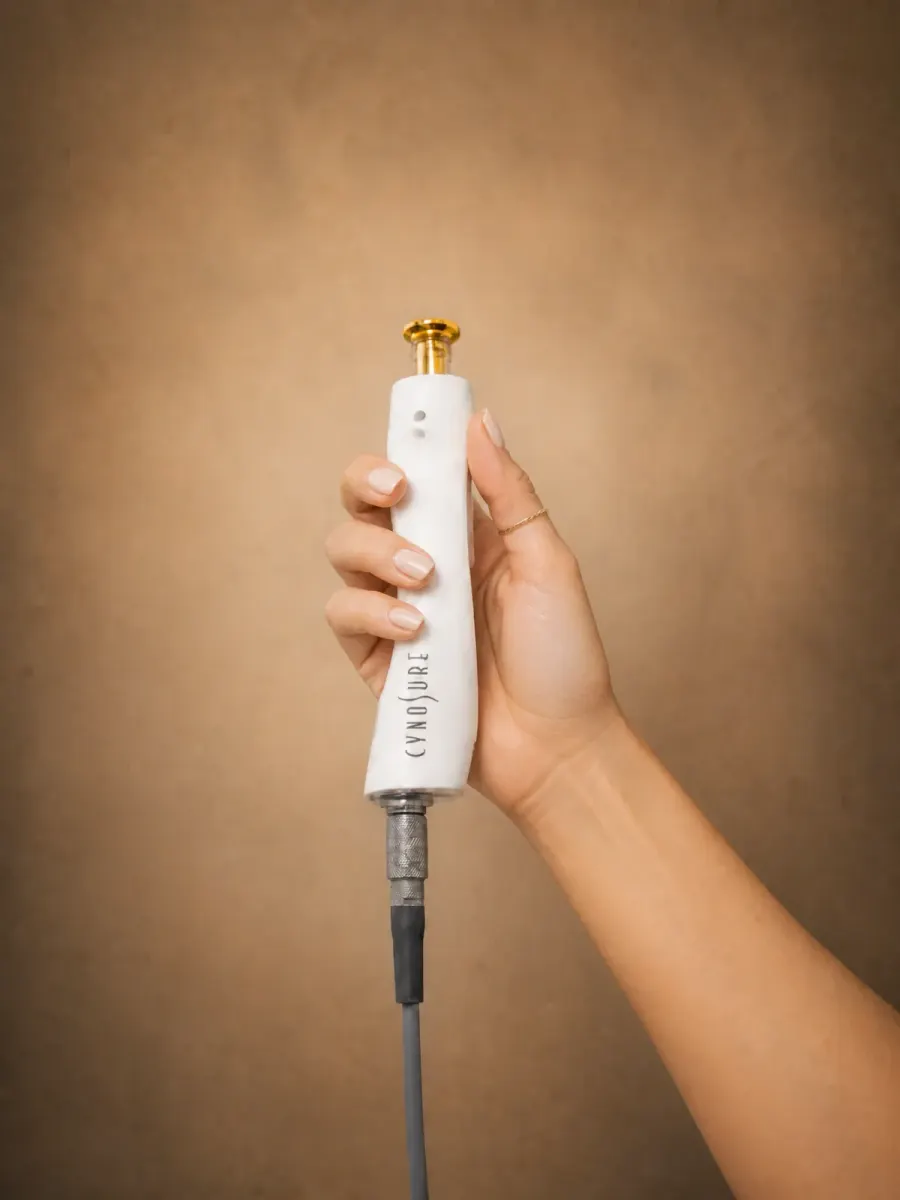
TempSure or XERF: two radiofrequencies, two depths of heat. Which one fits what you see in the mirror, and when the gentler one is truly enough.
The best plan starts with an assessment. We look at your skin and answer your questions, no obligation.

Hi, I am Stella. Ask me about a treatment, a price or the clinic, and I will point you to the right place.
Stella answers from the site. She does not diagnose and does not book. The conversation stays 24 hours on this device, and the clinic keeps a copy.