HIFU or Radiofrequency: Which One to Choose to Firm the Face
HIFU concentrates heat into points, radiofrequency spreads it through a volume. What that changes during the session, and who each one is for.

A home radiofrequency device does not do the same job as a medical one. Why that is, what it can still offer you, and where the line sits for safety.


A radiofrequency device sold for home use can be good for your skin as an upkeep routine. It won't do the work of a clinic device, because it's designed to stay safe with no one supervising it, so its heat stays near the surface.
Maybe you've seen one of these devices online, or you already have one in a drawer. No guilt needed. Here's why a home device is capped, what it can offer you, what it won't do, and how to check whether it's licensed in Canada.
They promise something appealing: firming at home, in the evening, with no appointment. The price looks reasonable next to a series of sessions, and before-and-after videos are everywhere. We understand the appeal.
Most pages that discuss them belong to device brands. For this article, we looked for independent studies on home radiofrequency devices and didn't find solid ones. What follows is based on how radiofrequency works, not on a trial comparing a home device with a medical one.
Radiofrequency works through heat. To restart collagen, that heat has to reach the deep layers of the skin, where collagen is made, without burning the surface. In a clinic, the device and the person holding it handle that together.
With XERF, according to the manufacturer Cynosure Lutronic, the device reads the skin's electrical resistance with every pulse and adjusts the energy, while cooling protects the surface. The medical aesthetician chooses depth and intensity, zone by zone.
A device sold for home use has no one to do that job. It has to stay safe in anyone's hands, on any skin, with no training. The only way to get there is to limit its power. Its heat then stays closer to the surface.
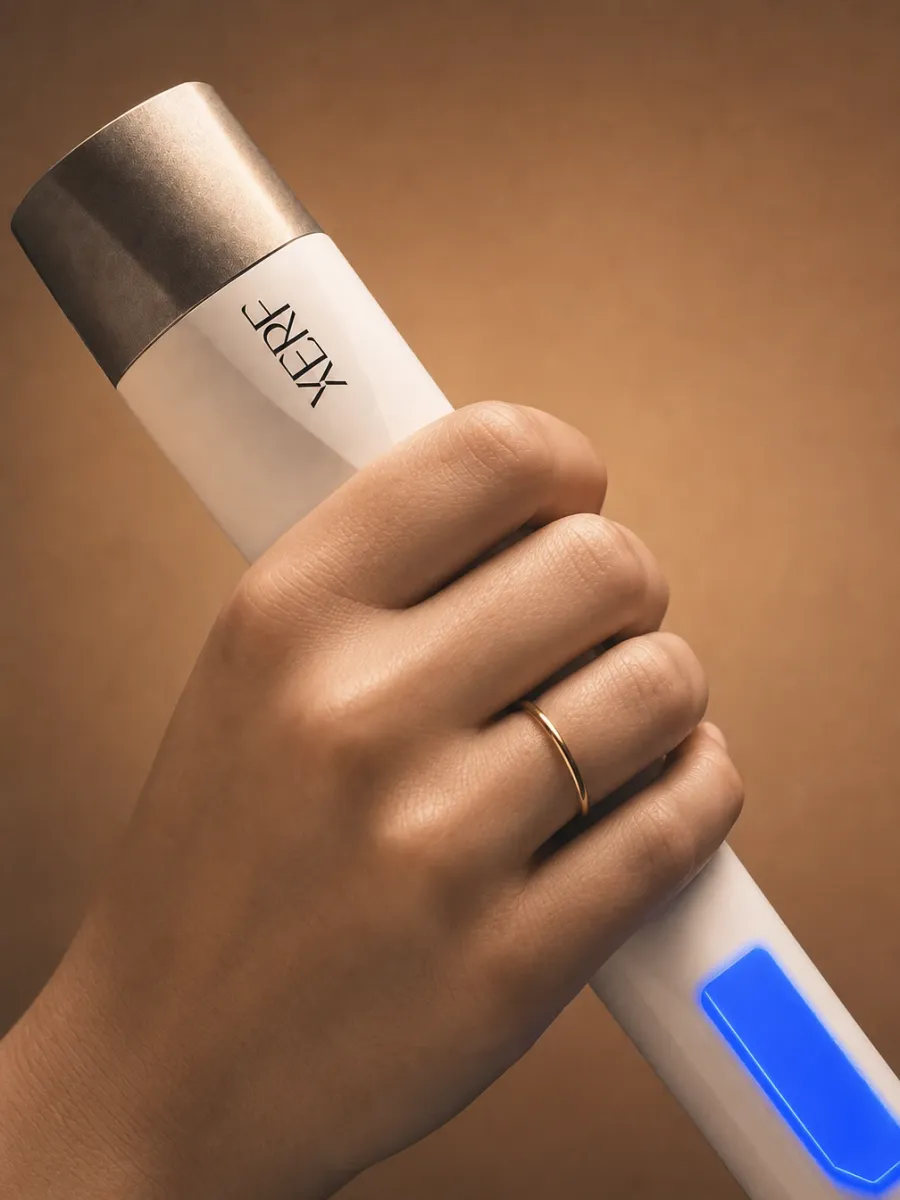
Is it money thrown away? Not necessarily. Used as an upkeep routine, a home device can:
If you like your device and it feels good, there's no reason to stop. You just need to know what you're asking of it.
A capped device won't replace a clinic session, even used every night. Repeating surface heat doesn't make it travel deeper. A softening jawline, a loosening neck or established collagen loss call for heat that reaches the supporting tissue.
| Home device | Clinic device | |
|---|---|---|
| Who sets it | No one: the power is fixed in advance | The device and the medical aesthetician, zone by zone |
| Where the heat goes | Closer to the surface | Down to the deep layers, according to XERF's manufacturer |
| What to expect | An upkeep routine | A treatment for laxity |
| Assessment first | None | An assessment and a LINE VU 3D skin analysis |
This table doesn't say a home device is useless everywhere. It says it doesn't do the same job.
Health Canada sorts medical devices into four classes, I to IV, based on risk. Classes II, III and IV must be licensed before they can be sold or imported in Canada. Class I doesn't need that licence.
For a home radiofrequency device, we didn't find an established class we could give you here. The simplest thing is to check yourself: Health Canada's database of licensed medical devices (MDALL) is public, and you can search it by device or manufacturer name.
A home device is designed to stay safe with no one supervising it. That's what limits its heat.
Poorly dosed heat can burn the skin, even with a capped device. A few points to keep in mind:
The possible side effects of in-clinic radiofrequency are explained in our article on side effects.
If you're after a moment of care and a routine, a home device has its place. If you're seeing laxity that bothers you, a jawline or neck that's changing, what you need is a treatment.
In the clinic, a XERF session covers the full face and neck, eye area included, for $1,500, taxes extra. We don't treat the décolleté yet. It's performed by a medical aesthetician, on a team that includes a former Cynosure trainer, after a LINE VU 3D skin analysis. We plan two sessions at minimum, then yearly upkeep; our article on the number of sessions explains why. For a gentler, repeated radiofrequency, there's also TempSure.
As an upkeep routine, they can bring comfort and a slight, temporary effect. They don't do a clinic device's work on laxity, because their power is limited to stay safe without supervision.
Yes, a burn is still possible if the device is misused. Follow the instructions and stop as soon as the skin becomes painful or blisters.
That's checked at the assessment. Bring your device's name: we'll look at whether it has a place between sessions.
Search its name or the manufacturer's in Health Canada's MDALL database, available online. Classes II to IV must be listed there to be sold in Canada.
We don't compare prices for devices we don't sell. A clinic session includes the assessment, the skin analysis and a medical aesthetician's work. Our price is listed on the treatment page.

HIFU concentrates heat into points, radiofrequency spreads it through a volume. What that changes during the session, and who each one is for.

Radiofrequency tightens skin that has lost its spring, but it doesn't remove skin. The signs that a surgical facelift is still the better option.

XERF radiofrequency firms mild to moderate laxity, with no needles. How it works, and when a facelift is still the better option.
The best plan starts with an assessment. We look at your skin and answer your questions, no obligation.

Hi, I am Stella. Ask me about a treatment, a price or the clinic, and I will point you to the right place.
Stella answers from the site. She does not diagnose and does not book. The conversation stays 24 hours on this device, and the clinic keeps a copy.