Receding Temples at 25: What You Can Do
Temples receding in your twenties? What the AAD says, what changes depending on the stage, and how DC Prime works while the follicle still responds.

More hair in the brush since September? What one study measured about seasonal shedding, and the signs that call for a proper assessment.

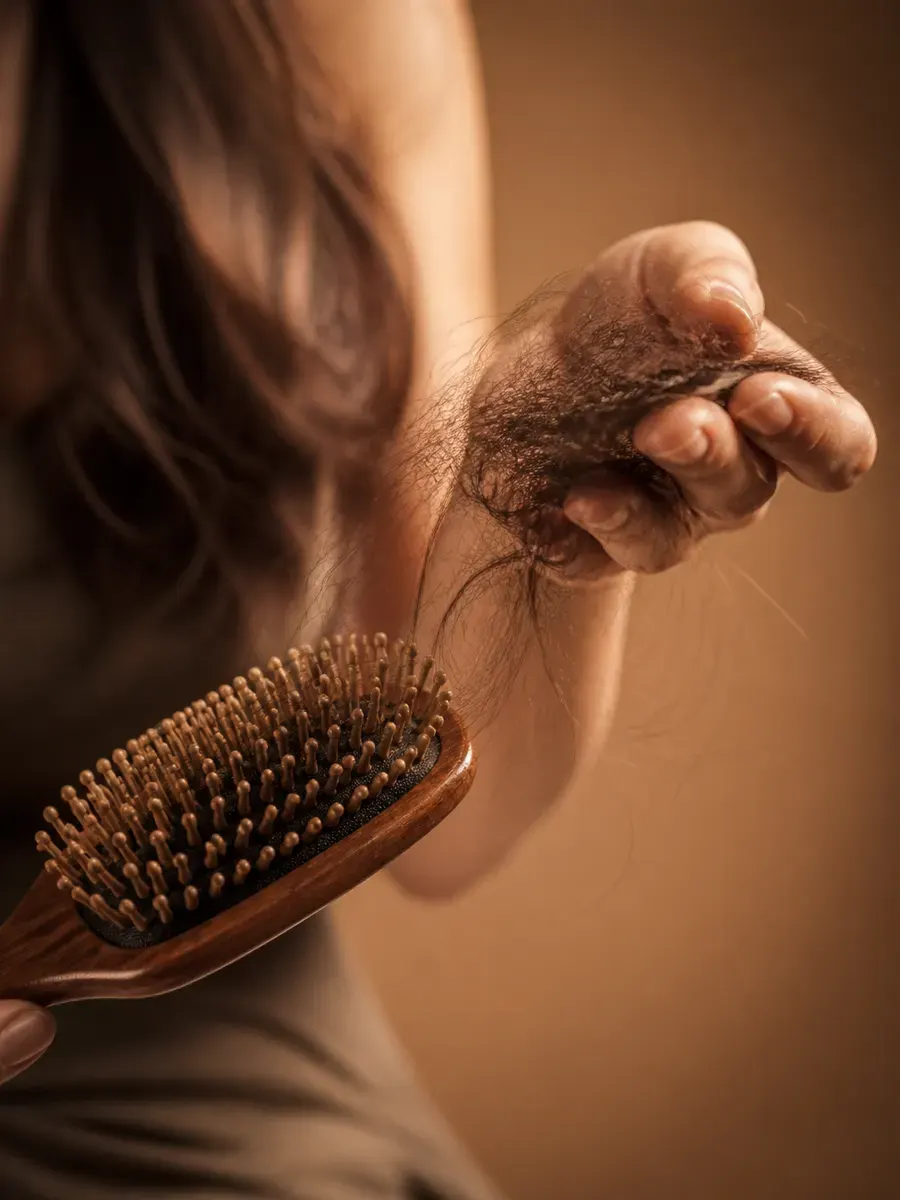
Since the end of summer, you're finding more hair in the brush, in the shower drain, on your sweater. You look at your part in the mirror and wonder if it's normal. It's a fair question, and the answer comes in two parts: what research has measured, and what a season can no longer explain.
The most cited work on the subject dates from 1991. According to Randall and Ebling (British Journal of Dermatology), the share of scalp follicles in the growth phase was above 90% in March, then hit its low point in September. Shedding peaked in August and September, at about 60 hairs a day.
The researchers followed participants for 18 months, with a measurement every 28 days. The pattern is read over a long period, not from a single sample.
One study measured a shedding peak in August and September. What lasts beyond that deserves an assessment.
A single follow-up of this quality is thin, and it has to be read with its limits:
It describes a pattern. It doesn't explain why the pattern exists, and it doesn't say whether your own shedding follows the same calendar. The figure of 60 hairs a day comes from those 14 men: it isn't a norm for everyone.
Here is a way to sort what you see. The signs in the last three rows are the ones the American Academy of Dermatology (AAD) describes for hair loss that is settling in.
| What you see | What it may mean | What we suggest |
|---|---|---|
| More hair in the brush and drain since late summer | Consistent with the August and September peak measured in 1991 | Watch, and follow how it goes over the coming weeks |
| Shedding still heavy well after fall | The season no longer explains it | An assessment |
| A widening part, a thinner ponytail | Gradual thinning, according to the AAD | An assessment |
| A hairline that is moving back | A sign described by the AAD | An assessment |
| Hair coming out in clumps | A sign described by the AAD | An assessment, without waiting |

A full brush doesn't tell you much, because you never remember last month's. A photo does.
It's a practical tip, not a medical test. It shows whether density is coming back or still dropping.
According to the AAD, hair loss has several possible causes, and only an assessment can tell which one is yours. A serious assessment starts by checking before proposing anything:
A blood test is something to discuss with your doctor. With us, the scalp assessment tells you whether that step is worth it.

If your photos show density isn't coming back, or if your part is widening, you don't have to wait for winter to ask the question. Our page on hair concerns explains the possible paths and what each one involves. To understand what may sit behind hair loss, read our page on hair loss too.
Shedding that follows a specific event, such as pregnancy, has its own calendar: we explain it in hair loss after pregnancy.
A 1991 study observed a shedding peak in August and September in 14 men in Sheffield. It describes a pattern without explaining its cause. If you see more hair, you aren't alone, but that doesn't replace an opinion if the worry lasts.
The study doesn't explain it, and neither do we: we won't invent a mechanism. If the shedding goes on past the fall, that's the sign to have it assessed.
The only figure we can source is the study's: about 60 hairs a day at the peak of shedding, in 14 men. It isn't a norm. What matters is the trend over several weeks, which your photos show you.
When your part is widening, your ponytail is getting thinner, your hairline is moving back, hair is coming out in clumps, or the shedding lasts beyond the fall. If it worries you, that's a good reason too.

Temples receding in your twenties? What the AAD says, what changes depending on the stage, and how DC Prime works while the follicle still responds.

Hair that falls out after childbirth usually grows back by itself. When to worry, what we check, and what DC Bloom can do if it doesn't.
Why combine PRP and exosomes in one hair protocol, how the session goes, and our programs that bring both together.
The best plan starts with an assessment. We look at your skin and answer your questions, no obligation.

Hi, I am Stella. Ask me about a treatment, a price or the clinic, and I will point you to the right place.
Stella answers from the site. She does not diagnose and does not book. The conversation stays 24 hours on this device, and the clinic keeps a copy.