At-Home Radiofrequency Devices: What They Can Do for Your Skin, and What They Can't
A home radiofrequency device does not do the same job as a medical one. Why that is, what it can still offer you, and where the line sits for safety.

XERF and Thermage belong to the same radiofrequency family. What sets them apart in plain facts, and the admission that no study compares them.

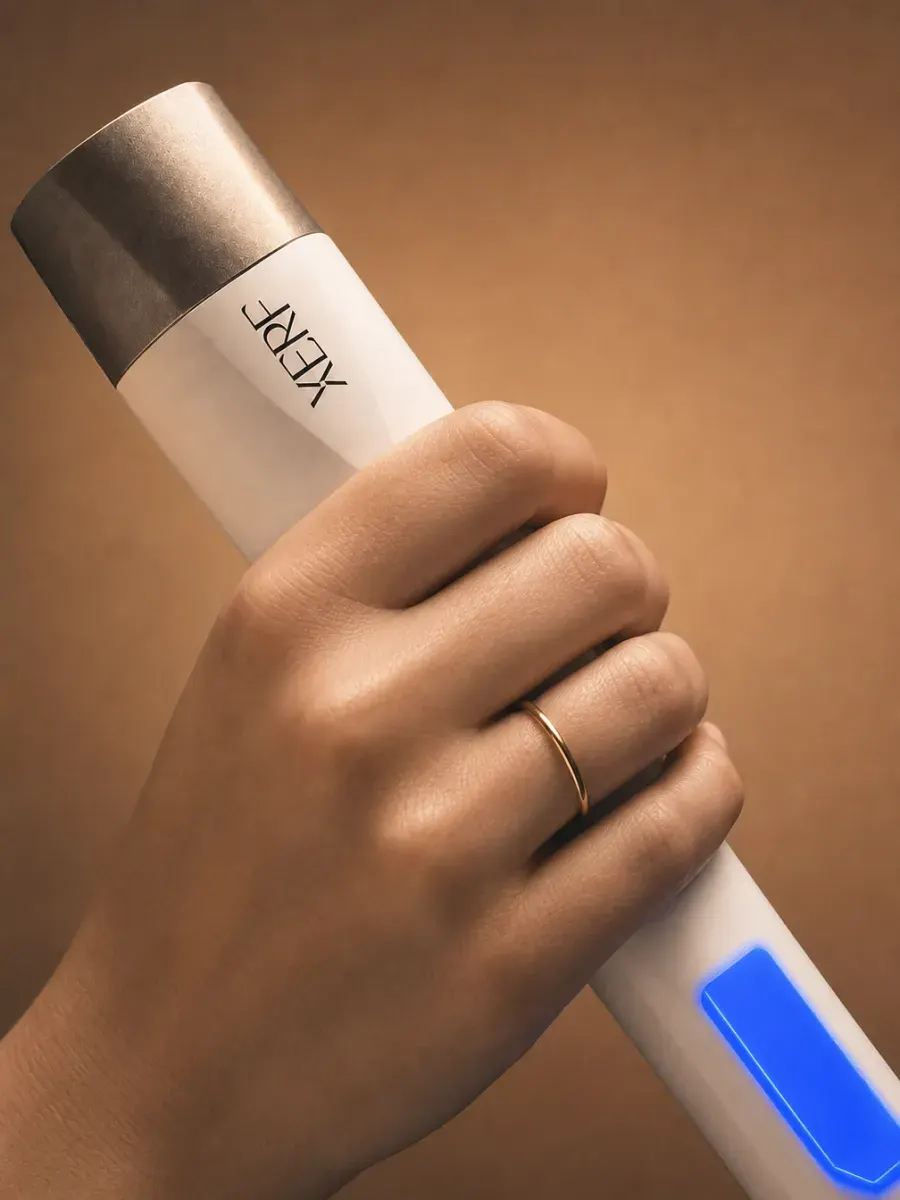
Is XERF better than Thermage? Nobody can say today: no published study compares the two devices head to head. What we can say is that they belong to the same family, monopolar radiofrequency, and that Thermage has a much longer published track record.
This article puts side by side what each manufacturer describes, what the literature establishes for the whole family, and what decides in practice. We offer XERF, not Thermage, so you will also read what ours does not have yet.
Monopolar radiofrequency sends a current into the skin through a single electrode placed on the area, and the heat builds in depth. That heat tightens existing fibres and restarts collagen production over several months.
XERF and Thermage do this same thing. They are not opposites like a laser and a needle: they are two devices of one method. If you are torn between this method and microneedles instead, that is a different question, covered in monopolar RF or RF microneedling.

XERF is made by Cynosure Lutronic. According to the manufacturer, it combines two frequencies (6.78 MHz and 2 MHz), cryogen cooling that protects the surface during each pulse, and a reading of the skin's resistance at every pulse to meter the energy.
These are technical descriptions, not results. Two frequencies do not mean a better outcome: no published measurement supports that claim. The device was authorized in Canada in April 2025.
Thermage FLX is made by Solta Medical, part of Bausch Health. According to the manufacturer, it builds in cooling and vibration during the treatment. Bausch Health announced its Health Canada clearance on April 29, 2025.
FLX is the fourth generation of Thermage, according to the manufacturer. Much of the family's literature was written on the earlier generations.
| XERF | Thermage FLX | |
|---|---|---|
| Manufacturer | Cynosure Lutronic | Solta Medical (Bausch Health) |
| Family | Monopolar radiofrequency | Monopolar radiofrequency |
| Frequencies, per the manufacturer | Two (6.78 and 2 MHz) | Not specified here |
| Cooling, per the manufacturer | Cryogen, at every pulse | Built in, with vibration |
| Arrival in Canada | April 2025 | Announced April 29, 2025 (FLX) |
| Published literature | Recent, still short | Long, across several generations |
| Offered at Clinique DC | Yes | No |
The two rows that matter most are the last two. The first says where Thermage has the edge; the second only says what we can offer you.
A systematic review published in Plastic and Reconstructive Surgery in 2022 gathered the clinical studies on monopolar and bipolar radiofrequency, on the face and body. Its authors conclude there is measurable improvement in laxity, with an acceptable complication profile, mostly minor and short-lived effects.
An older survey, published in Dermatologic Surgery in 2007, covered 5,700 monopolar radiofrequency facial treatments. It describes an earlier-generation device: it tells the family's history, it says nothing about the current model of either one.
No published study compares XERF and Thermage head to head. What we know applies to the family, not to one device against the other.
Pages that conclude "XERF is better" or "Thermage is better" are written by clinics that offer one of the two. None can cite a direct study, because we found none.
For your choice, that means two things:
So we won't tell you XERF does better. We will tell you what it takes and what it covers here.
If both devices do the same thing, the choice is made elsewhere:

The full details, with session length and what happens after, are on the XERF page. If your jawline is what bothers you most, the facial laxity page explains what is going on.
No study says so, and we don't say it either. Both do the same thing; Thermage has a longer published history, XERF arrived in Canada in 2025.
They use ultrasound, a different family from radiofrequency. The difference is explained in HIFU or radiofrequency.
It is another radiofrequency, with its own session rhythm. The comparison with XERF has its own article: TempSure or XERF.
We don't publish the price of a device we don't offer. What changes a radiofrequency price: the area covered, the number of sessions, and what the session includes.

A home radiofrequency device does not do the same job as a medical one. Why that is, what it can still offer you, and where the line sits for safety.

How radiofrequency, injectables and laser fit together without cancelling each other out: the clinic's lead times and the logic behind them.

Loosening skin and a receding jawline don't call for the same treatment. How to tell them apart, and when the two go together.
The best plan starts with an assessment. We look at your skin and answer your questions, no obligation.

Hi, I am Stella. Ask me about a treatment, a price or the clinic, and I will point you to the right place.
Stella answers from the site. She does not diagnose and does not book. The conversation stays 24 hours on this device, and the clinic keeps a copy.